Agent Engineering: A New Discipline
Agent engineering is a vital new discipline for transforming non-deterministic LLM systems into reliable production AI agents. It emphasizes an iterative build-test-ship-observe-refine cycle, enabling teams to manage unpredictability and deploy trustworthy, high-impact automated solutions.
Anyone who has developed an agent knows the significant gap between a functional prototype and a reliable production system. Traditional software development often operates with predictable inputs and defined outputs. Agents, however, present a unique challenge: user inputs are highly variable, and their potential behaviors are expansive. This inherent unpredictability is both their greatest strength and the source of unexpected issues.
Over the past three years, countless teams have grappled with these complexities. However, organizations like Clay, Vanta, LinkedIn, and Cloudflare have successfully deployed reliable agent systems to production by adopting an innovative approach: agent engineering.
What is Agent Engineering?
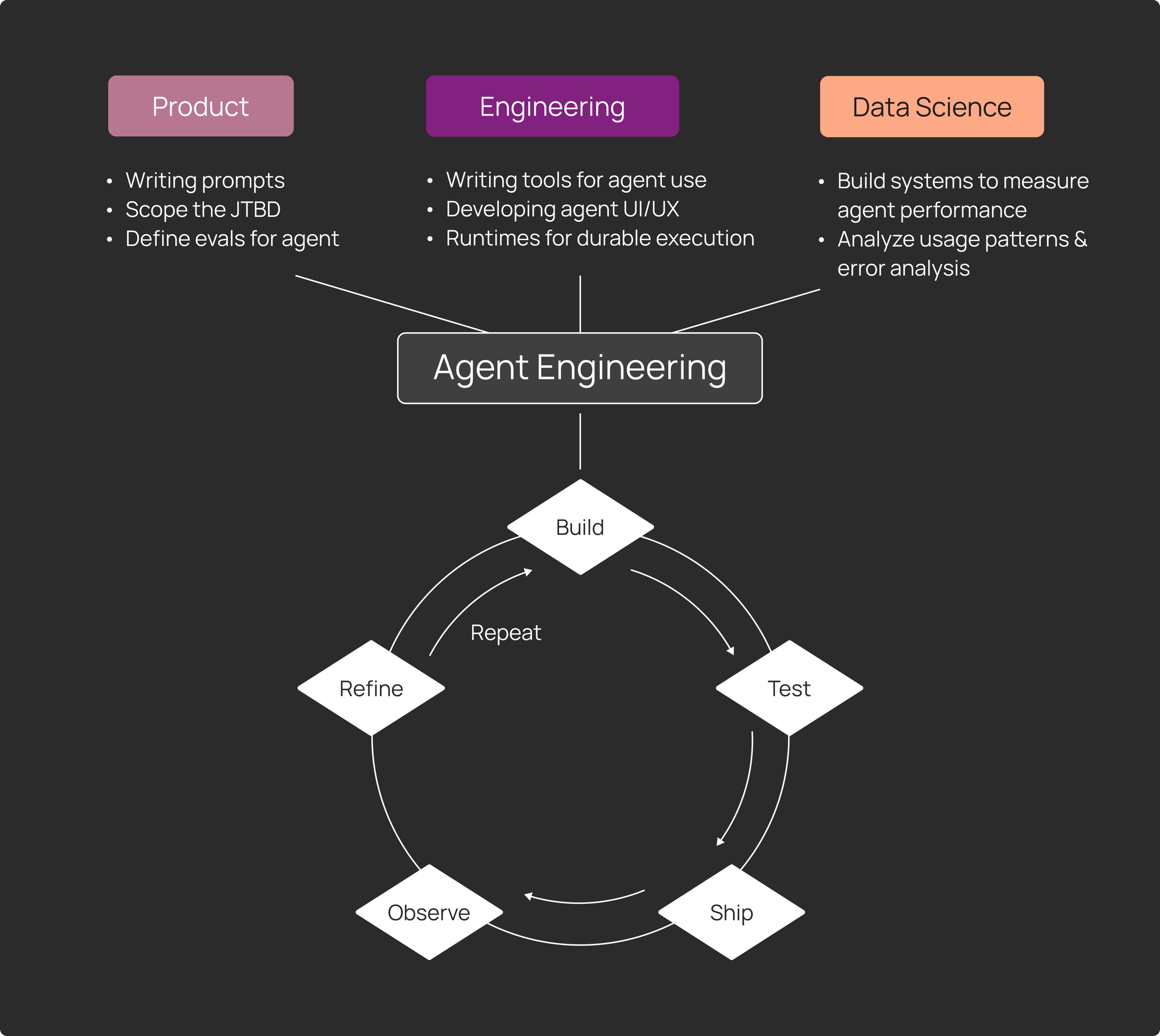
Agent engineering is defined as the iterative process of transforming non-deterministic Large Language Model (LLM) systems into dependable production-ready experiences. It follows a continuous, cyclical methodology:
- Build: Develop the agent's foundation.
- Test: Evaluate against scenarios.
- Ship: Deploy to observe real-world behavior.
- Observe: Monitor and analyze performance.
- Refine: Implement improvements based on observations.
- Repeat: Continuously iterate and enhance.
Crucially, deployment is not the culmination but rather a vital step in gaining new insights and improving agent performance. To drive meaningful enhancements, a deep understanding of production dynamics is essential. The quicker teams navigate this cycle, the more robust and reliable their agents become.
Agent engineering is an emerging discipline that synergizes three critical skillsets:
Product Thinking
Product thinking defines the agent's scope and shapes its behavior. This encompasses:
- Crafting prompts that effectively guide agent behavior, often spanning hundreds or thousands of lines, requiring strong communication and writing skills.
- Thoroughly understanding the core 'job to be done' that the agent is designed to accomplish.
- Establishing clear evaluation metrics to verify that the agent performs according to its intended purpose.
Engineering
Engineering builds the essential infrastructure required to make agents production-ready. Key responsibilities include:
- Developing specialized tools for agents to utilize.
- Designing user interfaces and user experiences (UI/UX) for agent interactions, incorporating features like streaming and interrupt handling.
- Creating robust runtimes capable of managing durable execution, human-in-the-loop pauses, and efficient memory management.
Data Science
Data science is focused on measuring and continuously improving agent performance. This involves:
- Constructing systems for evaluation (e.g., A/B testing, monitoring) to assess agent reliability and effectiveness.
- Analyzing usage patterns and conducting detailed error analysis, acknowledging the broader range of user interaction possibilities with agents compared to traditional software.
Where Agent Engineering Emerges
Agent engineering is not a new job title but rather a collection of responsibilities undertaken by existing teams developing systems that reason, adapt, and exhibit unpredictable behavior. Organizations successfully deploying reliable agents today are expanding the capabilities of their engineering, product, and data teams to manage the intricacies of non-deterministic systems.
Typically, agent engineering responsibilities manifest across various roles:
- Software Engineers and ML Engineers: Crafting prompts, building agent tools, tracing specific tool calls to understand agent decisions, and refining underlying models.
- Platform Engineers: Developing robust agent infrastructure capable of durable execution and human-in-the-loop workflows.
- Product Managers: Authoring prompts, defining agent scope, and ensuring the agent addresses the correct problem.
- Data Scientists: Measuring agent reliability and pinpointing areas for improvement.
These teams foster rapid iteration. It's common for software engineers to trace errors and collaborate with product managers to refine prompts based on those insights. Similarly, product managers might identify scope limitations necessitating new tools from engineers. All acknowledge that the true process of robustifying an agent occurs through a continuous cycle of observing production behavior and systematically refining the system based on acquired knowledge.
Why Agent Engineering, and Why Now?
Two fundamental shifts necessitate the rise of agent engineering.
First, Large Language Models (LLMs) have achieved sufficient power to manage complex, multi-step workflows. We are witnessing agents undertake complete jobs, not merely isolated tasks. For instance, Clay utilizes agents for comprehensive tasks ranging from prospect research to personalized outreach and CRM updates. LinkedIn employs agents to efficiently scan vast talent pools for recruitment, ranking candidates and instantly identifying the most suitable matches. We are now at a pivotal point where agents are delivering significant business value in production environments.
Second, this immense power is accompanied by inherent unpredictability. While simple LLM applications are non-deterministic, their behavior tends to be more constrained. Agents, by contrast, are distinct. They reason through multiple steps, invoke various tools, and dynamically adapt based on context. The very attributes that make agents so valuable also cause them to behave differently from traditional software. This typically implies:
- Every input is an edge case: There is no 'normal' input when users can articulate requests in natural language. Phrases like 'make it pop' or 'do what you did last time but differently' can be interpreted in diverse ways by an agent, similar to human understanding.
- Traditional debugging methods are insufficient: Given that a significant portion of the logic resides within the model, developers must meticulously inspect each decision and tool call. Minor adjustments to prompts or configurations can lead to substantial shifts in behavior.
- 'Working' is not a binary state: An agent might boast 99.99% uptime yet still be fundamentally flawed or 'off the rails.' Critical questions lack simple yes/no answers, such as: Is the agent making appropriate calls? Is it using tools correctly? Is it adhering to the underlying intent of the instructions?
Considering these factors—agents executing high-impact workflows with behaviors beyond the scope of traditional software solutions—it becomes clear there is both an opportunity and an imperative for a new discipline. Agent engineering empowers organizations to leverage the full potential of LLMs while concurrently constructing trustworthy production systems.
What Does Agent Engineering Look Like in Practice?
Agent engineering operates on a fundamentally different principle than traditional software development. For a reliable agent system, deployment is the primary mechanism for learning, rather than the final step after learning.
Successful engineering teams typically adopt the following cadence for agent development:
- Build Your Agent's Foundation: Begin by designing the agent's core architecture, whether it involves a simple LLM call with specific tools or a sophisticated multi-agent system. The architecture choice hinges on the desired balance between structured workflows (deterministic, step-by-step processes) and dynamic agency (LLM-driven decision-making).
- Test Based on Imagined Scenarios: Evaluate the agent against example scenarios to identify clear issues with prompts, tool definitions, and workflows. Unlike traditional software development where user flows can be extensively mapped, it's impossible to foresee every interaction when dealing with natural language input. The mindset shifts from "test exhaustively, then ship" to "test reasonably, ship to learn what truly matters."
- Ship to Observe Real-World Behavior: Upon deployment, previously unforeseen inputs will immediately emerge. Every production trace reveals the actual range of scenarios your agent must handle.
- Observe: Thoroughly trace every interaction to understand the complete conversation flow, every tool invoked, and the precise context informing each agent decision. Conduct evaluations on production data to measure agent quality across criteria such as accuracy, latency, and user satisfaction.
- Refine: Once patterns in failures are identified, refine the agent by editing prompts and adjusting tool definitions. This is a continuous process; problematic cases can be integrated back into example scenarios for regression testing.
- Repeat: Deploy improvements and monitor changes in production. Each cycle provides new insights into user interactions and clarifies the definition of reliability within your specific context.
A New Standard for Engineering
Teams successfully deploying reliable agents today share a common approach: they have moved past attempting to perfect agents pre-launch, instead embracing production as their primary learning environment. This involves meticulously tracing every decision, evaluating performance at scale, and deploying improvements rapidly—often in days rather than quarters.
Agent engineering is emerging as a necessity driven by opportunity. Agents are now capable of managing complex workflows that historically demanded human judgment, but this potential is only realized if they can be made sufficiently reliable and trustworthy. There are no shortcuts; only the systematic, iterative process yields dependable results. The critical question is not whether agent engineering will become standard practice, but rather how swiftly your team can adopt it to fully unlock the transformative capabilities of agents.