AI: A Black Mirror Reality Outside the Tech Bubble
This article explores the growing chasm between AI enthusiasm within the tech world and public apprehension, illustrated by an AI experiment visualizing *Black Mirror* ratings. It highlights concerns regarding job displacement, fake content, and AI's impact on human identity, suggesting AI feels like a 'Black Mirror' episode to many.
I am excited to see the progress in AI. But not everyone shares this sentiment. Outside of the tech bubble, AI is an invasive technology with no opt-out options. This post explores the contrast between the author's enthusiasm for using AI to visualize Black Mirror season ratings and the stark reaction from the internet.
Drawing Charts with AI
In early 2025, explorations were made into creating and styling charts with AI, specifically using image models to go beyond traditional ggplot2 and Grafana visuals.
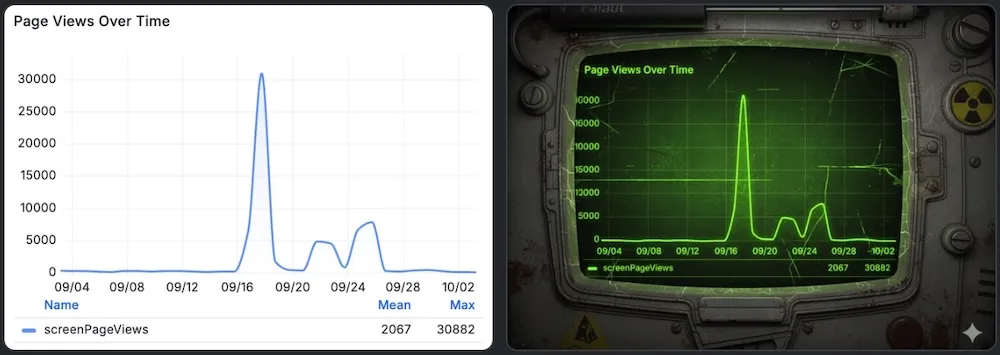
A prompt for Gemini 2.5 Flash Image (Nano Banana) was: "Turn this style to Fallout. Content needs to stay precisely the same."
Initially, styling charts with AI proved unreliable. It often took too much creative liberty, altering data significantly, making it suitable only for cherry-picked results. However, the newest Nano Banana Pro, with its enhanced capabilities, including infographic creation, promises improved styling accuracy and the potential to generate charts from scratch.
Black Mirror Vibes
The author holds a strong appreciation for Black Mirror seasons 1-4 for their dark, intense themes, aesthetics, and focus on substance. Curious about the quality of the latest season, the idea emerged to leverage AI to obtain and visualize season ratings in the show's distinct style.
Plain Nano Banana Pro within Google AI Studio was insufficient for this task. It lacked external search capabilities and was limited by its training data, notably asserting that Season 7 did not exist – a common issue with models having cut-off dates, leading to errors such as AI not knowing the subsequent year.
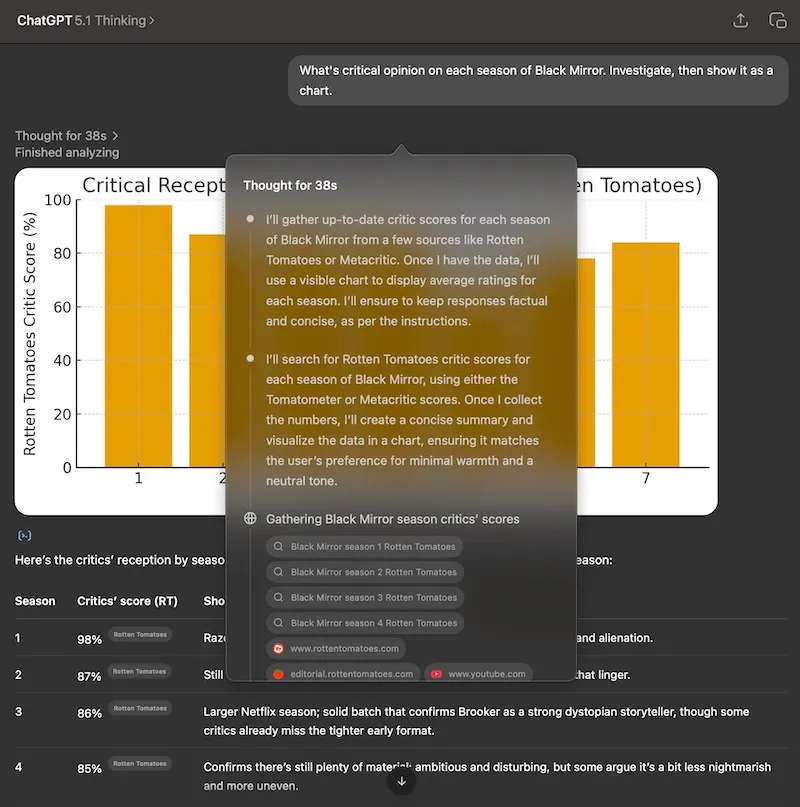
To overcome this, a two-stage process was employed. First, ChatGPT 5.1 Thinking was used to gather critical reception data for Black Mirror seasons from Rotten Tomatoes, including both viewer and critic scores, presented in a table.
The prompts used were:
- "What’s critical opinion on each season of Black Mirror. Investigate, then show it as a chart."
- "Are viewers’ reviews similar?"
Subsequently, the output from ChatGPT was used as a prompt for Nano Banana Pro.
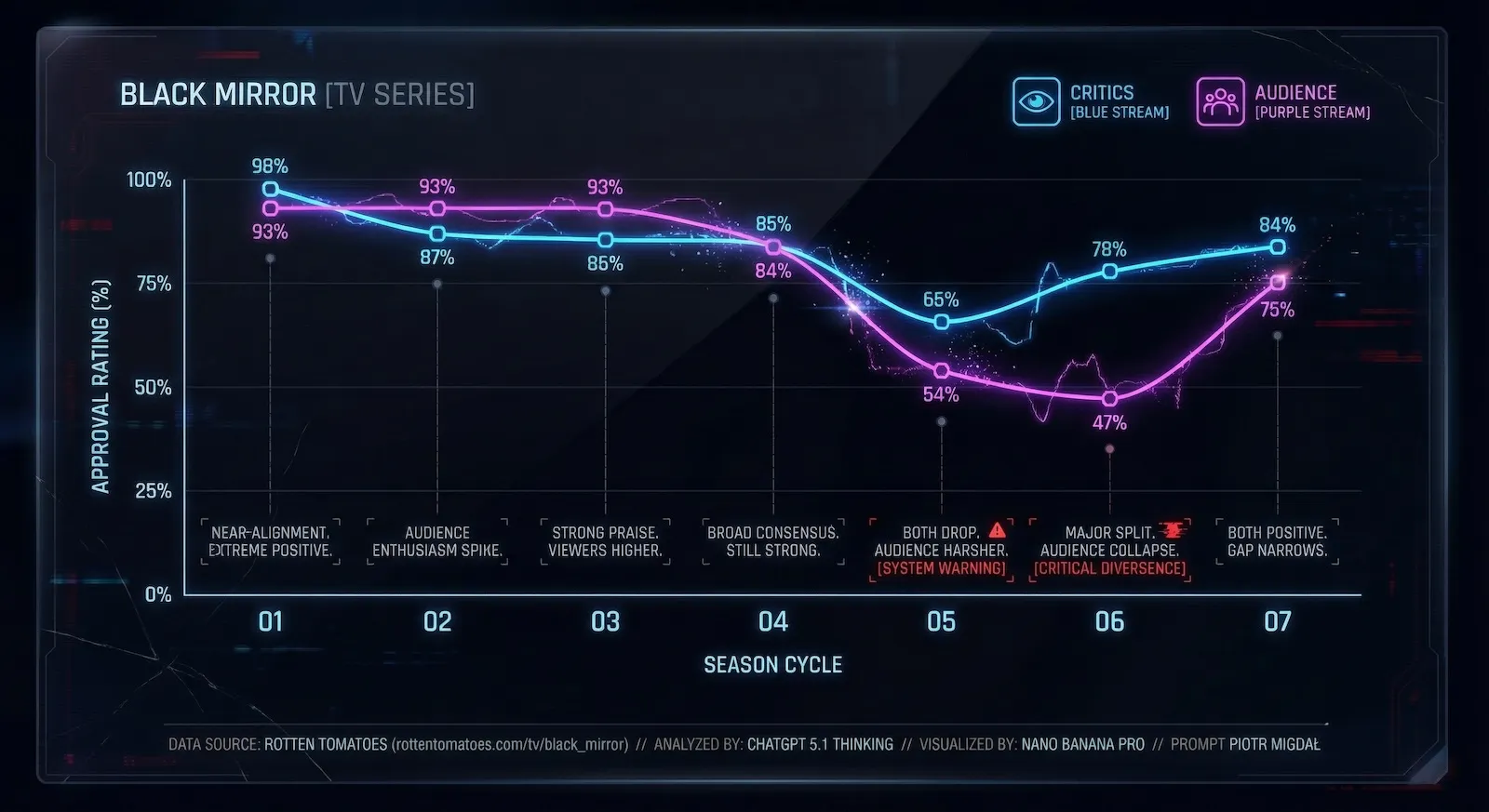
The prompt provided was: "Create a chart - minimal, yet in aesthetics of Black Mirror - on its reception. For comments - keep these low, not full sentences as in data below. Be faithful to numbers, though. Data comes from Rotten Tomatoes, https://www.rottentomatoes.com/tv/black_mirror. Data analyzed by ChatGPT 5.1 Thinking, visualized by Nano Banana Pro.
Data:
| Season | Critics | Audience | Relationship |
|---|---|---|---|
| 1 | 98% | 93% | Both extremely positive, near-alignment. |
| 2 | 87% | 93% | Critics very positive, audience even more enthusiastic. |
| 3 | 86% | 93% | Same story: strong critical praise, viewers slightly higher. |
| 4 | 85% | 84% | Almost identical; broad consensus it’s still strong. |
| 5 | 66% | 54% | Both see a drop; audience significantly harsher than critics. |
| 6 | 78% | 47% | Major split: critics think it’s a decent rebound, audience score collapses. |
| 7 | 84% | 75% | Both positive; viewers still cooler than critics but gap narrows again. |
A small edit was made to the generated chart:
- The title was changed to "BLACK MIRROR [TV SERIES]".
- "Terminal ID" was replaced with "PROMPT AUTHOR".
Public Reception
The author excitedly shared the AI-generated visualization online, first on Facebook and then on the r/blackmirror subreddit, titled "Using AI to chart Black Mirror’s acclaim feels like living in the future." The post included a note: "Is the new season of Black Mirror any good? I asked ChatGPT to tell me and Nano Banana Pro to turn it into a chart. We live in the future. The Black Mirror future. But still—the future."
Anticipating positive feedback, especially given the data suggesting an improved latest season, the author was met with an overwhelmingly negative response.
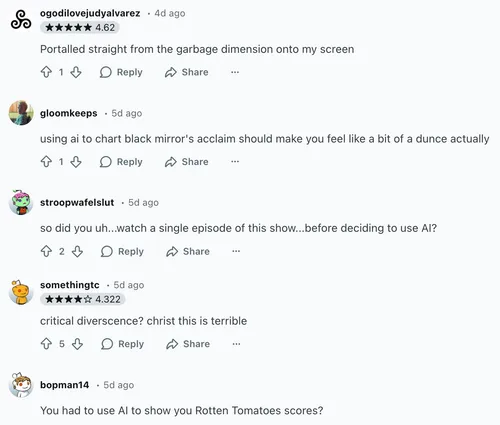
The Reddit post was removed, a common occurrence on the platform. More surprisingly, the reception was unanimously harsh, despite the likelihood that most commenters couldn't create such graphics themselves.
Social media responses varied. While some expressed intrigue or curiosity about the prompts, others were simply irritated by the use of AI.
One pop-culture blogger questioned the use of AI instead of manually checking Rotten Tomatoes. The author countered by asking about the "virtue in copy-and-paste" for data spanning seven pages. This prompted another user to ask, "Is there a virtue in getting dumb by using AI?"
The author acknowledges the potential for "dumbing down" through AI misuse, particularly with uncritical copy-pasting. However, they advocate for using AI to expand knowledge, especially for discovering concepts without prior search terms, citing an example of learning about phonesthemes.
Outside the Bubble: AI as a 'Black Mirror' Reality
Using any tool, including AI, comes with inherent responsibilities. If AI fabricates information (confabulates) and is shared unchecked, it is the user's fault. Similarly, misattributing or failing to attribute sources is a user error.
However, a significant portion of the public does not perceive AI merely as a tool. When AI malfunctions, it's often labeled "stupid" and subjected to intense scrutiny not applied to human errors. Conversely, when AI performs well, it's sometimes viewed even more negatively.
AI, as a "disruptive tech," generates friction on multiple levels:
- "Intellectual Plastic": Its low creation cost floods social media with synthetic content, making it harder to find quality human-made work.
- Fake Content: It simplifies the creation of deceptive content, diminishing superficial polish as a quality indicator and necessitating double-checking of data.
- Job Displacement: It threatens jobs, both those people value and those they rely on.
- Identity Challenge: It questions fundamental human identities related to intellect, creativity, and even spirituality.
Stepping outside the "tech bubble" provides a refreshing yet sobering perspective. The enthusiasm prevalent in communities like Hacker News, AI Tinkerers, or AI labs is far from widespread.
Those involved in training AI models or developing AI-assisted tools must recognize that to avoid public backlash, efforts must be directed towards making AI beneficial for humanity while simultaneously making misuse more difficult. The precise solution remains elusive.
For many, AI feels like a Black Mirror episode they never consented to, casting those within the tech community as antagonists in their narrative.