AWS CEO Highlights 3 Reasons Why AI Won't Replace Junior Developers
AWS CEO Matt Garman challenges the notion that AI will replace junior developers, offering three compelling reasons why these roles are crucial and how AI should instead enhance workplace productivity.
AWS CEO Highlights 3 Reasons Why AI Won't Replace Junior Developers

AWS CEO Matt Garman outlined three compelling reasons why companies should reconsider cutting junior developer roles, emphasizing that these emerging professionals “are actually the most experienced with the AI tools.”
3 Reasons AI Should Not Replace Junior Developers
In a tech world often preoccupied with AI replacing human workers, Matt Garman, CEO of Amazon Web Services (AWS), is pushing back against one of the industry’s most popular cost-cutting notions.
Speaking on WIRED’s The Big Interview podcast, Garman delivered a bold message to companies rushing to cut costs with AI.

He was asked to explain why he once called replacing junior employees with AI “one of the dumbest ideas” he’d ever heard, and to elaborate on how he believes agentic AI will truly transform the workplace in the coming years.
1) Junior Developers Often Know AI Tools Better
First, junior employees frequently demonstrate greater proficiency with AI tools compared to their senior counterparts.
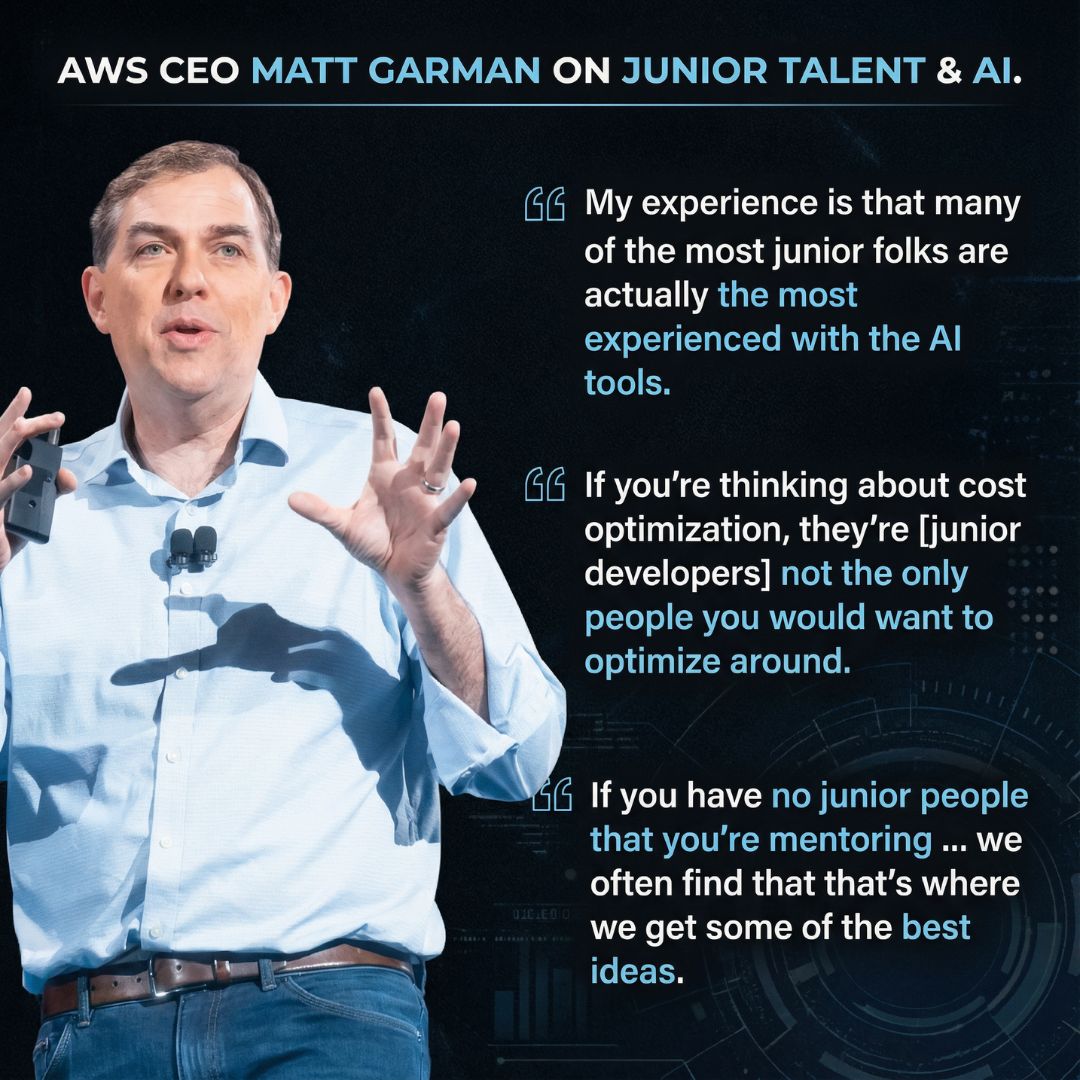
“Number one, my experience is that many of the most junior folks are actually the most experienced with the AI tools. So they're actually most able to get the most out of them.”
Fresh graduates have grown up immersed in new technology, allowing them to adapt quickly. Many gain familiarity with AI-powered tools during their studies or internships. They tend to explore new features, discover efficient coding methods, and learn how to extract optimal results from AI agents.
According to the 2025 Stack Overflow Developer Survey, 55.5% of early-career developers reported using AI tools daily in their development process, a figure higher than for experienced professionals.
This inherent comfort with new tools enables them to work more efficiently. In contrast, senior developers often have established workflows that may require more time to adapt to new technologies.
Recent research shows that over half of Gen Z employees are actively helping senior colleagues upskill in AI.
2) Junior Developers Shouldn’t Be The Default Cost-Saving Move
Second, junior staff are typically the least expensive employees.
“Number two, they're usually the least expensive because they're right out of college, and they generally make less. So if you're thinking about cost optimization, they're not the only people you would want to optimize around.”
Junior employees usually command significantly lower salaries and benefits, meaning their removal does not lead to substantial savings. From a purely financial standpoint, targeting them for cost optimization often lacks significant impact.
Therefore, when companies discuss increasing profit margins, junior employees should not be the default or sole target. True optimization and genuine cost-cutting necessitate a holistic company-wide review, as numerous other areas offer potential for expense reduction.
In fact, 30% of companies that laid off workers expecting savings ended up increasing expenses, with many subsequently needing to rehire.
3) Removing Juniors Breaks the Talent Pipeline
Third, companies require a continuous influx of fresh talent.
“Three, at some point, that whole thing explodes on itself. If you have no talent pipeline that you're building and no junior people that you're mentoring and bringing up through the company, we often find that that's where we get some of the best ideas.”
Consider a company akin to a sports team. If you retain only veteran players and never recruit rookies, what happens when those veterans retire? You're left with a critical skill gap.
Moreover, hiring individuals directly from college introduces new perspectives and innovative thinking into the workplace. They bring fresh ideas shaped by the latest trends and a strong motivation to innovate.
More importantly, they form the foundation of a company’s future workforce. If a company ceases to hire junior employees altogether, it severs its own talent pipeline. Over time, this leads to a scarcity of internal candidates for leadership roles.
A Deloitte report also notes that the tech workforce is expected to grow at roughly twice the rate of the overall U.S. workforce, underscoring the demand for tech talent. Without a robust pipeline of incoming junior developers, companies could face a significant tech talent shortage.
When there are insufficient junior hires being trained today, teams will struggle to fill critical roles tomorrow, particularly as projects scale.
Bottom Line
This isn’t merely corporate rhetoric. As the leader of one of the world’s largest cloud computing platforms, serving clients ranging from Netflix to U.S. intelligence agencies, Garman possesses unique insight into how companies are truly leveraging AI.
What he observes leads him to worry that short-term thinking could inflict lasting damage on businesses. Garman’s perspective is rooted in long-term strategic vision. A company that relies solely on AI to manage tasks without cultivating new talent risks future staffing challenges.
Garman concedes that the next few years will be challenging. “Your job is going to change,” he stated, expressing his belief that AI will enhance productivity for both companies and their employees.
When technology simplifies a process, demand for it typically increases. AI accelerates software creation, enabling companies to develop more products, enter new markets, and serve a broader customer base.
Developers will evolve beyond simply writing code, with rapid adaptation to new technologies becoming increasingly essential. Yet, he concludes with an optimistic outlook.
This aligns with Geoffrey Hinton’s advice that Computer Science degrees remain essential. Fresh talent with a strong understanding of core fundamentals will be crucial for filling these higher-value roles of the future.
“I’m very confident in the medium to longer term that AI will definitely create more jobs than it removes at first,” Garman affirmed.