Critical React Security Update: Act Now & Explore Modern Frontend Techniques
Urgent React 19.0-19.2.0 update required for RCE vulnerability. Explore TanStack Start features, WhatsApp system design, 22 new CSS techniques, and top AI coding tools.
Critical React Security Update: Act Now & Explore Modern Frontend Techniques
A critical security vulnerability has been identified in React, necessitating immediate action for users running React 19.0-19.2.0 with Server Components. This article provides comprehensive details on the vulnerability, alongside a deep dive into TanStack Start, an analysis of WhatsApp's system design, and an overview of 22 modern CSS features.
This article is sponsored by Tambo, an open-source SDK for React components. Tambo revolutionizes the development of admin panels and dashboards by transforming your React components into generative UI. Instead of manually coding forms and filters, developers can register components once and enable natural language interaction. For example, typing “Show me sales from last quarter” prompts AI to render the appropriate component with the correct props. Learn more about building generative UI with Tambo.
1. Deep Dive: Key Features of TanStack Start
For those new to TanStack Start, now is an excellent time to explore this robust framework. Developed by the React Query team and powered by Vite, TanStack Start offers file-based routing without vendor lock-in, seamless server functions, and comprehensive type safety. Its features include full-document SSR, streaming, server/API routes, RPC-style server functions, middleware and context, full-stack bundling, universal deployability, and end-to-end TypeScript safety. To illustrate its capabilities, a Netflix clone was developed, incorporating trending movies, search functionality, and a video player. Here are the most critical aspects of TanStack Start to understand:
Server Functions
Server functions are a core strength of TanStack Start, enabling developers to write server-only logic—such as database fetches, secret access, or file I/O—and invoke it from client components or loaders while maintaining full type safety across the boundary.
// src/serverFns.ts

import { createServerFn } from '@tanstack/react-start';

export const getMovieTrailers = createServerFn().handler(async () => {
  // Only runs on server
  const res = await fetch(
    `https://api.themoviedb.org/3/movie/${movieId}/videos?language=en-US`
,
    {
      headers: {
        Authorization: `Bearer ${process.env.TMDB_AUTH_TOKEN}`
,
        'Content-Type': 'application/json'
      }
    }
  );
  // ...
  // other code
});
These functions can be seamlessly called from client components or loaders:
export const Route = createFileRoute('/watch/$movieId')({
  loader: async ({ params }) => {
    // ...
    const trailers = await getMovieTrailers({ data: { movieId: movieIdNum } });
    const trailer = trailers[0];

    return { trailer };
  },
});
Server Routes
For those who prefer traditional API routes over RPC, TanStack Start provides robust support through file-based routing within the routes/ directory.
// src/routes/hello.ts
import { createFileRoute } from '@tanstack/react-router';

export const Route = createFileRoute('/hello')({
  server: {
    handlers: {
      GET: async ({ request }) => {
        return new Response('Hello, World!');
      },
    },
  },
});
This approach delivers SSR and streaming for enhanced performance and SEO, without compromising client-side interactivity.
Automatic Caching
Given that TanStack Start is built upon TanStack Router, it inherits powerful features like automatic loader caching, ensuring instant navigation. It offers Stale-while-revalidate caching out-of-the-box, automatically refetching data based on dependencies without additional configuration.
Intent-based Preloading
TanStack Start implements intent-based preloading, initiating data fetching when a user hovers over a link, even before they click. This results in an exceptionally smooth user experience, such as instant video player loading due to prefetched trailer data.
Dynamic Routes
Dynamic routes, exemplified by /watch/$movieId, include runtime parameter parsing and validation using Zod. This prevents invalid access (e.g., /watch/abc) and ensures robust type flow from loaders to components.
2. Critical Vulnerability: Urgent React App Updates Required
A remote code execution (RCE) vulnerability with a maximum severity rating (CVSS 10.0) has been identified in React Server Components. This critical flaw enables attackers to execute arbitrary malicious code on servers by sending specially crafted HTTP requests to React Server Function endpoints.
Affected Versions:
This vulnerability impacts React versions 19.0 through 19.2.0 within packages such as react-server-dom-webpack, react-server-dom-parcel, and react-server-dom-turbopack. Applications utilizing frameworks like Next.js, React Router, Waku, and Expo with React Server Components are susceptible, even if they do not explicitly implement Server Function endpoints.
Specifically affected are React 19.0-19.2.0, Next.js 15-16, React Router with RSC, Waku, Expo Router, and various associated bundler plugins.
Resolution: Users must upgrade to React 19.0.1, 19.1.2, or 19.2.1 immediately. For Next.js projects, it is imperative to update to the latest patch (versions 15.0.5 through 16.0.7). Comprehensive upgrade instructions are available in the official advisory.
3. System Design: Architecting WhatsApp
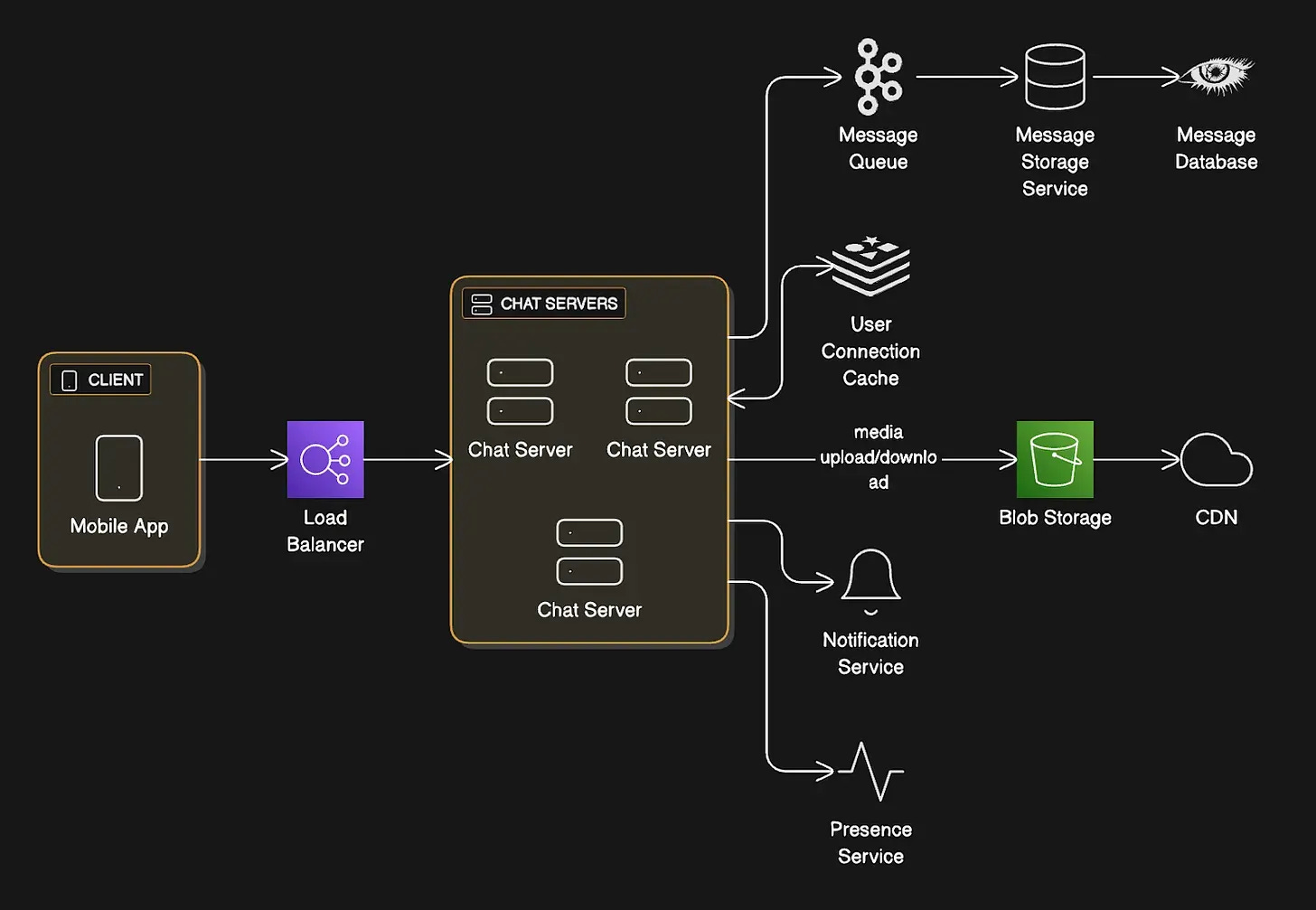
This analysis details the architectural design of a real-time messaging application, focusing on the core components required for users to exchange text and media. It elucidates the functions of the chat server, message queue, storage service, and message database. Furthermore, the article explores WhatsApp's reliance on WebSockets for most connections and provides a comparative overview of polling, long polling, and WebSockets. This content is highly valuable for anyone interested in scalable system design, regardless of interview preparation.
4. Exploring 22 New CSS and UI Features
This section highlights several innovative CSS and UI features:
- Declarative Dialogs and Popovers: Manage dialogs and popovers declaratively using
commandforandcommandattributes, eliminating the need for JavaScript. Buttons can now directly trigger actions such asshow-modal,hide-popover, and custom commands. - Native Select Element Styling: Finally, native
<select>elements can be styled effectively usingappearance: base-selectto customize dropdowns. - Carousel Styling: Achieve advanced styling for carousels with pseudo-elements like
::scroll-buttonand::scroll-marker. - Star Rating Components: Construct sophisticated star rating components leveraging the advanced
attr()function. - ToggleEvent.source: Utilize
ToggleEvent.sourceto precisely identify which button initiated a toggle event.
select {
  &::picker(select) {
    appearance: base-select;
  }
}
5. Top 5 AI Tools for Daily Coding
Amidst numerous coding tools launched this year, here are five AI tools consistently used for daily development:
- ChatGPT: Utilized for various general tasks.
- Claude: Preferred over ChatGPT for code-specific tasks.
- CodeRabbit: Essential for code reviews, integrated into every pull request workflow.
- GitHub Copilot: Continues to be a reliable tool for autocomplete and generating boilerplate code.
- Convex: The primary database choice for AI application development.
Quick News
- Bun Acquired by Anthropic: The high-performance JavaScript runtime and toolkit, Bun, has been acquired by Anthropic to bolster AI-powered development tools.
- Cloudflare Outage: Cloudflare experienced another global service outage on December 5, attributed to a firewall update rather than a cyberattack.
- TanStack AI Launched: A new toolkit, TanStack AI, is now available for developing AI-powered applications, featuring streaming capabilities, type-safe APIs, and a framework-agnostic design.