Dapr: Simplifying Microservices and Distributed Applications in Cloud Native Environments
Dapr, a CNCF graduated project, streamlines microservices development. It simplifies state management, pub/sub, and observability, enabling efficient and scalable cloud-native applications.
Microservices have been with us for nearly two decades, yet developing them at scale in a polyglot environment remains challenging. The Dapr project, the Distributed Application Runtime, is an open-source graduated project under the Cloud Native Computing Foundation (CNCF) specifically designed to address these complexities.
The Need That Sparked Dapr
Building microservices inherently involves distributed system challenges: connecting services, tracing asynchronous events, handling failures, dynamic scaling, and managing caching and messaging. Before Dapr, developers had to manually implement these patterns. For instance, tracing often required integrating OpenTelemetry SDKs, wiring trace propagation through Kafka headers, and coordinating requests across multiple services.
Even in large organizations, these issues were apparent at scale. Teams dedicated significant resources and months to simply maintain consistency across distributed workloads. Dapr was conceived to eliminate these inefficiencies, drastically reducing development time from months to mere minutes for a single developer.
Dapr provides an application runtime for building microservices on Kubernetes. It operates as an intelligent sidecar alongside your application, managing essential cross-cutting concerns like messaging, publish-subscribe (pub-sub), service-to-service communication, storage, caching, and secrets management. This architecture allows the application to focus solely on its business logic, interacting only with the local Dapr sidecar.
The Journey to Open Source
Dapr was open source from its inception, a deliberate design philosophy rather than an afterthought. Yaron Schneider, Dapr's co-creator, emphasized how his team advocated for a strong developer focus within a predominantly DevOps-oriented company. This approach ultimately served broader DevOps goals, as he explained:
"The biggest win wasn’t just that developers could write code faster — it was that a single DevOps engineer could standardize an entire workflow in minutes instead of months. That’s the power that drove us to make Dapr open source from day one."
Dapr was an early indicator of the CNCF's evolving focus beyond pure DevOps, expanding to encompass developers, platform engineering, FinOps, and other emerging areas within the cloud-native ecosystem.
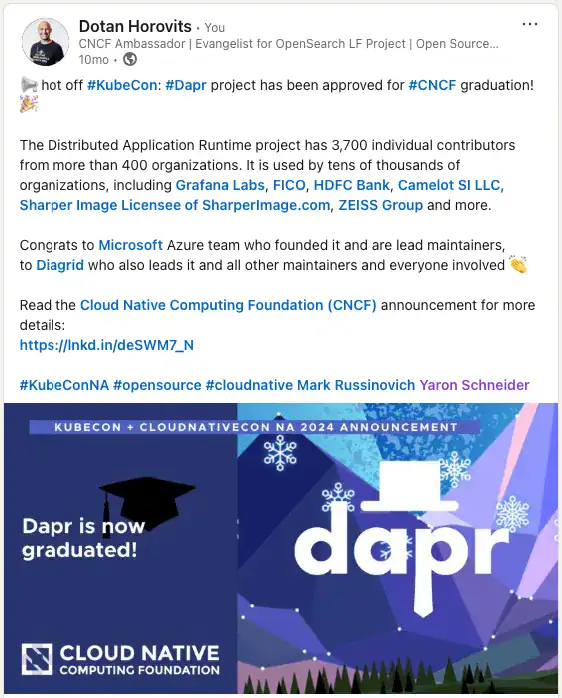
The decision to join the CNCF proved strategic, attracting early adoption from major players like Alibaba and HashiCorp. Dapr's maturity allowed it to bypass the CNCF sandbox, becoming the first project to join as an incubating project in 2021. Its graduation during KubeCon NA (October 2024) marked a significant milestone, reflecting its robust community of thousands of individual contributors from hundreds of organizations.
Built-in Observability
One of Dapr’s most compelling features is its built-in observability. Developers are freed from manually instrumenting services to collect metrics or traces. Dapr automatically propagates context across both asynchronous systems (e.g., Kafka, SQS) and synchronous systems (e.g., HTTP).
As Yaron Schneider articulated, "The trace is the only thing you need to know. You won’t even need SDKs in your code… Dapr will just show you the entire call graph."
Developers can configure a single YAML file to send all traces to their preferred OpenTelemetry-compatible backend, such as Jaeger, Zipkin, or AWS X-Ray. Metrics are similarly integrated; Dapr can connect to a database, allowing Prometheus to scrape golden metrics (request rate, error rate, latency) without any code modifications. This sidecar pattern, akin to service meshes like Istio, offers an elegant and scalable solution for observability.
Latest Capabilities and Roadmap
Dapr continues to evolve, with recent innovations focusing on workflows and AI/LLM integration. Workflows enable the orchestration of distributed processes as if they were a single transaction, complete with full observability via OpenTelemetry. Dapr’s Conversation API abstracts multiple LLM providers (e.g., OpenAI, Anthropic, AWS Bedrock) while adding enterprise features such as PII obfuscation.
The recently announced Dapr Agents, an agentic framework contributed by NVIDIA and jointly maintained with Diagrid, enhance multi-step autonomous workflows with durability and failure recovery. This prevents the wasteful re-execution of costly LLM calls in case of failures, saving both computational resources and expense.
A Perfect Companion to KEDA
Dapr simplifies distributed application development, abstracting away much of the boilerplate complexity. However, Dapr alone is only part of the solution. KEDA (Kubernetes Event-driven Autoscaling) serves as its natural complement; once Dapr enables event-driven workloads, KEDA seamlessly handles dynamic autoscaling.
Crucially, Dapr and KEDA share a common ecosystem of integrations, ensuring a smooth synergy. Yaron Schneider explained the intentional design overlap:
"When I basically designed both KEDA and Dapr, I wanted them to make sure that they overlap so that… you can immediately autoscale it with KEDA. You only need two YAML files."