Europe's Sovereign Challenges: A Deep Dive into Free Speech, Tech, and Economic Realities
Europe grapples with a deepening reality gap, risking future sovereignty due to dependencies in energy, security, and tech. This analysis examines free speech limitations, a struggling tech sector, economic stagnation, and security shortfalls, highlighting a need for strategic shifts to foster growth and independence.
Europe faces a widening gap between its self-perception and current realities, a disconnect that threatens the continent's future. Increasing dependencies in energy, security, software, and manufacturing are challenging Europe's sovereignty, yet its political leadership often adheres to policies that have not proven effective over recent decades.
A prominent example is the issue of free speech, highlighted by the €120 million fine recently imposed on X. While framed around concerns of "deceptive design" and "transparency for researchers," the European Union's broader intentions became clear when it announced this regulatory initiative in 2023 with charges pertaining to "dissemination of illegal content" and "information manipulation," interpreted by some as censorship.
Furthermore, critics argue the justification for the fine is inconsistent. Meta, for instance, offers an identical paid verification scheme to X, yet, according to Elon Musk, it faces no similar investigation because it has allegedly cooperated with EU content moderation demands. Public reception also casts doubt on the "deceptive design" claim, as X remains a top-ranked download across European countries.
This regulatory pressure on X is understood by many as an attempt to enforce cooperation with EU content moderation policies. For example, German politician Friedrich Merz has reportedly initiated over 5,000 cases pursuing individuals for online insults, leading to instances of house raids for comments as minor as calling him a "filthy drunk."
Germany is not an isolated case. The UK has reportedly arrested over 10,000 people per year since 2020 for social media posts, and even for activities like silent prayers. France also records thousands of annual cases related to speech offenses. This environment naturally discourages users from openly expressing views online when public figures face repercussions for their tweets.
Given these widespread arrests for minor online comments or criticism of government policies, some find it challenging to reconcile Europe's self-image as a champion of free speech and freedom of the press with the prevailing reality.
Beyond free speech concerns, the X fine also underscores the fragility of the European tech sector. Notably, the income generated by the EU's tech-related fines in 2024 reportedly exceeded the total income taxes paid by all public internet tech companies within Europe, highlighting a stark economic reality.
This trend stems from Europe's diminished capacity to foster new, large-scale companies over the past fifty years. As former giants like Nokia declined, a void emerged with insufficient replacements. The number of new European companies valued at $10 billion or more created in the last half-century remains exceptionally low.
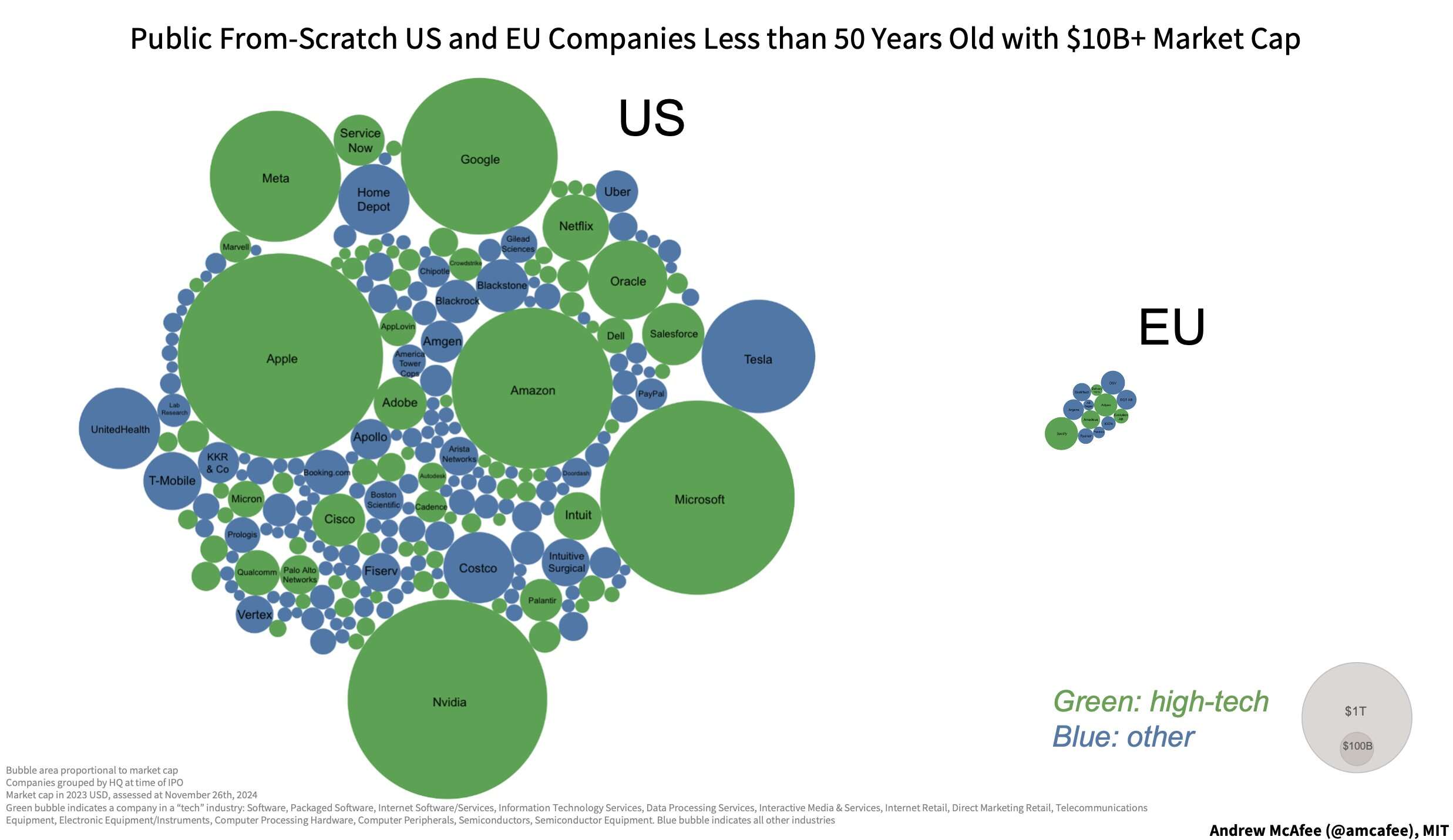
Even Europe's established industrial powerhouses are facing challenges. Germany's real GDP has not grown in five years, with its competitiveness impacted by net-zero policies and energy costs now 2-3 times higher than those in America and China. This comes despite Germany's investment of approximately €700 billion in green energy projects, and Europe's overall contribution being only 6% of global emissions. Concurrently, the EU collectively paid over twenty billion euros to Russia for energy in 2024.
This leads to discussions about security. European leaders have expressed frustration at being excluded from key discussions regarding the resolution of the war in Ukraine, which are primarily occurring between America and Russia. However, this exclusion is partly attributed to their own defense commitments. Below is a breakdown of NATO spending by country:
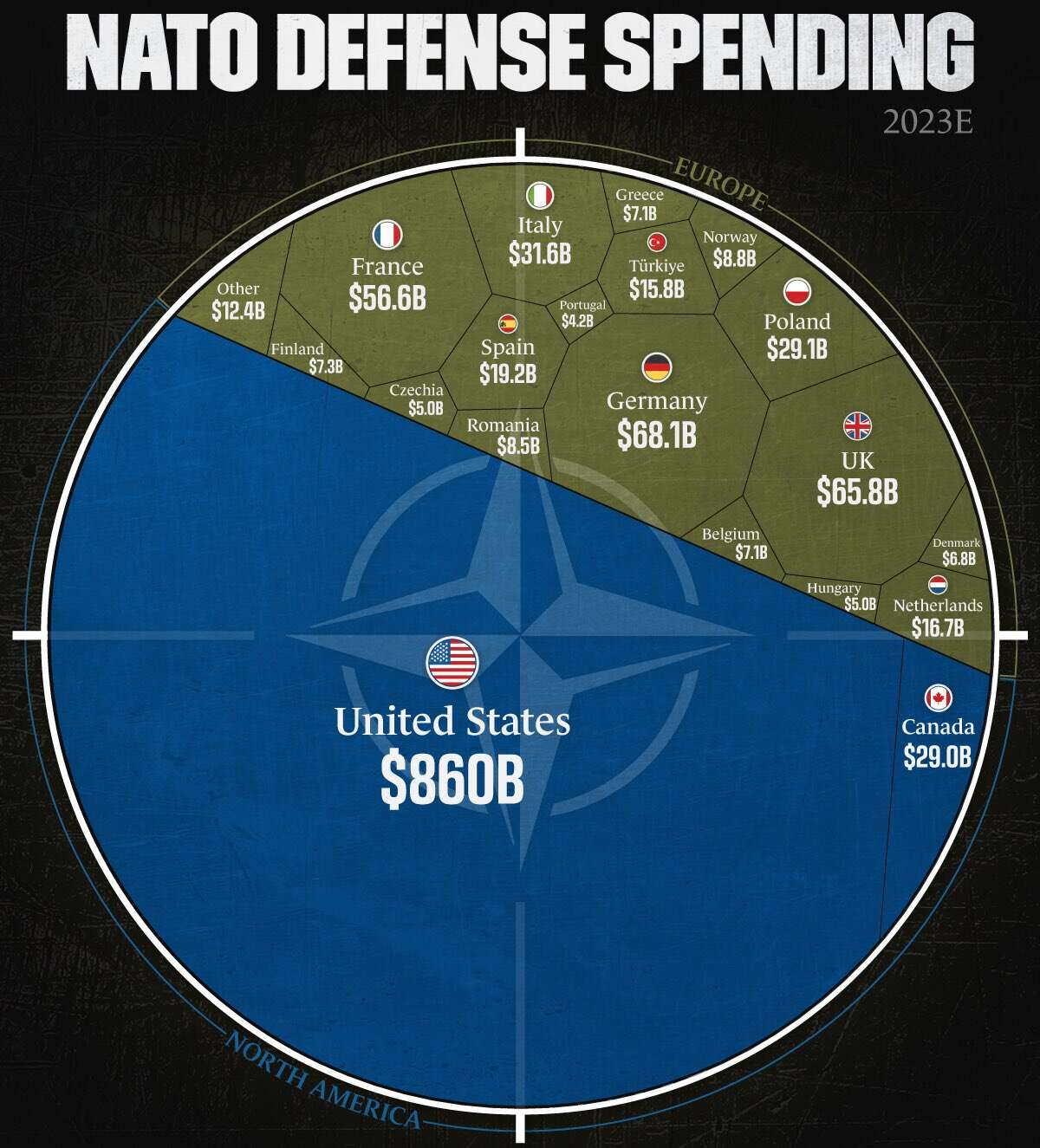
Historically, America's substantial military spending was often a point of European jest. However, since the invasion of Ukraine, this perception has shifted, and the new official NATO target for member states is to spend 2% of GDP on defense.
Even if European countries meet this 2% target (with only Poland among larger EU nations currently approaching it), their collective defense spending would still significantly trail America's, primarily due to the EU's comparatively smaller and contracting economic footprint.
In 2025, the European Union's combined GDP was $20 trillion, while America's was fifty percent larger at $30 trillion. This disparity is projected to grow, with EU growth estimated at roughly 1% in 2024 compared to nearly 3% for the US.
When confronted with these economic figures, some argue that Europe offers a superior quality of life compared to America, despite its GDP per capita being almost half.
While the subjective appeal of living in Europe is undeniable, this does not negate America's significantly greater wealth, a factor that influences commercial dominance and military power.
The economic trajectory is particularly concerning. In 2008, Europe's GDP was nearly on par with America's. If the current growth rate disparity (1% for Europe vs. 3% for the US) persists for another decade, America's economy could expand by another third to $40 trillion, while Europe's might only grow by 10% to $22 trillion, making the American economy nearly twice as large.
These statistics present a sobering outlook for Europe, ranging from the thousands of annual arrests for social media posts in the UK to the projected risk of its economy shrinking to half the size of America's within a decade.
Despite these challenges, Europe is not predestined for this trajectory. It possesses some of the world's most creative, capable, and ambitious individuals (evidenced by the significant percentage of US startup unicorns with European founders). However, it must offer stronger incentives for these talents to remain, beyond what the EU and the UK currently provide.
Suggested solutions include significantly lower energy costs to foster a competitive industrial base and power the AI revolution, advocating for a revival of European nuclear energy. A more strategic immigration policy, akin to America's focus on attracting top talent, is proposed instead of what is described as mass immigration that might not be beneficial to the economy and society. The article also recommends abandoning censorship initiatives and bureaucratic inefficiencies like the Digital Services Act (DSA), and establishing a unified European internal market for remote labor and a consolidated stock exchange for listings.
Numerous alternative paths exist that avoid a future characterized by low growth, censorship, and the continued emigration of top talent to other global hubs. Urgent action is therefore advised.