From Signal Processing Skeptic to Expert: Titus Roesler's Transformative MIT Journey
Discover Titus Roesler's remarkable transformation from a quiet student unsure of signal processing to a passionate educator and aspiring expert, shaping his own academic path and inspiring peers at MIT.
Titus Roesler, initially on the verge of dropping his signal processing class, now aspires to be an expert in the field. This remarkable journey is chronicled by Frances Klemm, an MIT News correspondent, with the article published on October 22, 2025.
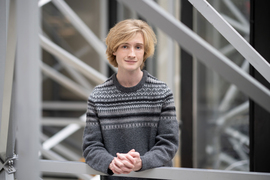
Caption: “I don't know that anyone who knew me pre-MIT would believe that I do things like give recitations to crowded rooms, because I think everyone thought, ‘Titus is that quiet kid, he never talked at all,’” says Titus Roesler. Credits: Photo: Bryce Vickmark

Caption: “I don't know that anyone who knew me pre-MIT would believe that I do things like give recitations to crowded rooms, because I think everyone thought, ‘Titus is that quiet kid, he never talked at all,’” says Titus Roesler. Credits: Photo: Bryce Vickmark
Coming from a small high school in rural South Dakota that didn’t offer advanced placement (AP) classes, Titus Roesler ’25 faced a challenging start at MIT. However, his dedication to catching up academically with his peers unexpectedly led him to a job as a teaching assistant, a role that profoundly changed his academic trajectory.
Roesler, who earned his bachelor's degree in electrical engineering last spring and is currently pursuing a master's, has established a strong reputation as a student-teacher at MIT. Since discovering his passion for teaching and mentoring, he has served as a teaching assistant for four different courses and independently designed two seminars.
Through teaching, Roesler has not only supported other students but also deepened his own understanding of complex subjects. This includes signal processing, a field focused on manipulating signals like radio waves to enhance their utility for applications such as wireless communications. He has developed a strong fascination with the topic and hopes to continue his work in this domain.
While Roesler's enthusiasm for teaching is evident today, he didn't always envision this path.
“I don't know that anyone who knew me pre-MIT would believe that I do things like give recitations to crowded rooms, because I think everyone thought, ‘Titus is that quiet kid, he never talked at all,’” he remarks.
Learning through teaching
Growing up in Marion, South Dakota, a town with a population of around 800, MIT was initially not on Roesler's radar, though he always enjoyed mathematics. His high school capstone project involved assisting classmates with the math section of the ACT, and he tutored several peers. His teacher even allowed him to teach trigonometry for a day, and he toured local colleges with aspirations of becoming a high school math teacher.
However, this changed after he independently studied calculus using MIT’s OpenCourseWare offerings, setting his sights on the Institute.
Roesler dedicated extra effort during his first year at MIT to bridge the academic gap with his peers, many of whom had access to advanced high school curricula. On his first physics exam, he correctly answered only one question—a multiple-choice guess. Fortunately, MIT’s Experimental Study Group (ESG) provided crucial support during his freshman year, quickly opening doors to further opportunities.
In the spring of his first year, when his multivariable calculus instructor asked him to stay after class, Roesler was convinced he was in trouble. Instead, she wanted to inquire if he would be interested in serving as a TA for her the following year.
“I was flattered because there was still a month left in the class. Plenty of time for me to fail,” Roesler jokes.
He thoroughly enjoyed the role. During one Friday night office hour session, he stayed extra hours to assist a student in whom he saw much of himself—someone from a rural background who had also entered MIT without a strong mathematics foundation. He later became that student's tutor. This position allowed him to be the supportive teacher he had always wished for.
As a TA, Roesler explains, “I wasn't coming at things from the perspective of ‘Everyone already knows A, B, C’ before I explained. I would always try to start from the ground up and give my perspective on it.”
His mentorship and teaching efforts earned him the Undergraduate Teaching Award from the Department of Electrical Engineering and Computer Science (EECS) and the Outstanding Associate Advisor Award from the Office of the First Year. After joining ESG as a freshman, Roesler continued as an associate advisor in the learning community for the next three years. His dedication was recognized with the Fiekowsky Award for Excellence in Teaching and the Fiekowsky Award for Community Service.
The right blend
Signal processing, the focus of his graduate work, “is where calculus, geometry, linear algebra, probability, statistics, algorithms, and numerical analysis all come into play on practical problems of real-world interest,” Roesler states. “For me, it’s the right blend of theory and application.”
Given the field’s broad scope, Roesler constantly identifies potential applications for signal processing and observes how various disciplines intersect within it. “Everything comes together in just the right way,” he notes.
He is particularly interested in signal-processing challenges like source separation, which aims to recover individual source signals from a mixture of signals. During his senior year, he dedicated two semesters to a project involving a Python program he developed to separate harmonies in Bach chorales.
For his master’s degree, following a summer research internship at MIT Lincoln Laboratory, Roesler has remained at the laboratory, now exploring high-frequency radio communications. He is currently engaged in a research project that applies the theory of compressed sensing (which posits that, under specific conditions, signals can be reconstructed from very few measurements) to communications.
What truly captivates Roesler are “something-from-nothing” problems.
“The kind of problems I’m interested in are underdetermined, inverse problems,” he explains. He gives an example: imagine trying to reconstruct a complete image from only a handful of pixels. While seemingly impossible, researchers have successfully recovered high-quality images by applying compressed sensing techniques.
Running and serving
Roesler has also dedicated significant time to running, a sport he has cherished since fifth grade. In 2023, he completed a marathon in 2 hours and 46 minutes and subsequently ran the Boston Marathon in both 2024 and 2025. To prepare, he extensively studied the psychology of running, an experience he credits as his first foray into using the scientific method. Now, he runs for enjoyment, finding it a way to focus and gather his thoughts.
Beyond his academic pursuits and running, he has served on the executive team of the Undergraduate Mathematics Association, as a resident peer mentor at Baker House, and as a tutor for two classes. At the PKG Center, he has been both a program lead and counselor for its pre-orientation program.
Roesler continues to find immense satisfaction in witnessing the impact of his teaching. At the end of one semester, after teaching a tutorial, he organized a picnic for his class. To his delight, they surprised him with a card and a bag of goodies.
Recalling the moment, he says: “I thought, How does it get better? It was wonderful.”