Introducing the Developers' Cloud: Appwrite's Evolution to a Full Product Lifecycle Platform
Appwrite transforms into a comprehensive developer cloud, supporting the full product lifecycle from build to deploy, observe, and protect. It reduces overhead and integrates AI for productivity.
Introducing the Developers' Cloud
This open letter addresses the Appwrite community regarding our future. Appwrite is evolving beyond simply a backend platform; we are building towards the most complete cloud development platform to date.
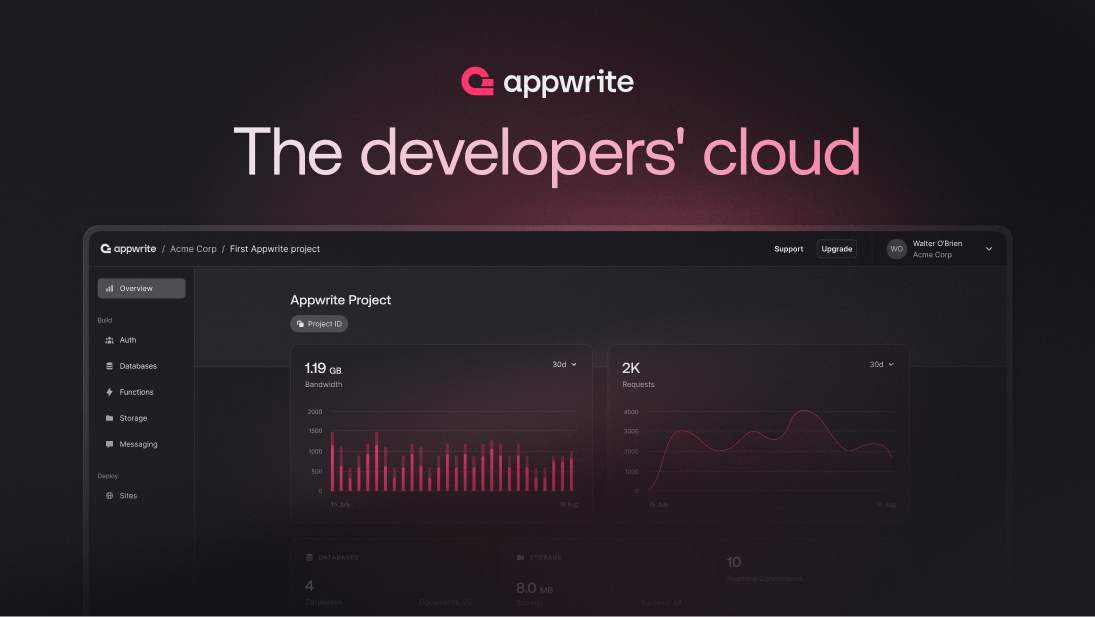
Technology continuously reshapes the world, with developers at the core of this transformation. Their creativity and problem-solving skills convert ideas into meaningful products. From its inception, Appwrite was designed to foster this creativity. Our mission has always been clear: to make software development accessible, developer-centric, and flexible by building with and for the open-source community.
Over the past few years, Appwrite has become recognized as a reliable backend platform. We focused on empowering developers during the build stage, with Auth, Databases, Functions, Messaging, and Storage forming the backbone of that experience. Together, these components helped teams accelerate from idea to working product with less complexity and fewer decisions.
However, every product journey extends beyond the initial build. Teams inevitably face questions like:
- Where do we deploy?
- How do we go live?
- How do we scale?
- How do we secure and observe our systems in production?
This is where overhead accumulates. Developers often find themselves stitching services together, managing integration complexities, and maintaining mental models across multiple, disparate platforms.
Today, Appwrite has evolved to address more of this extensive journey. We are no longer just a backend.
Evolving the Platform
Appwrite is becoming a more complete experience for developers, extending our capabilities across the full lifecycle of product development. This signifies not a change in mission, but a natural progression in fulfilling it – providing developers with everything they need to create and innovate without limits, all within a single environment.
With the recent launch of Appwrite Sites, you can now deploy and host your applications directly through Appwrite. This marks the first major milestone in supporting the journey beyond the build phase. You can take your project live, scale it, and operate it with the same thoughtful developer experience and flexibility that have always defined Appwrite.
We envision this journey as a continuous chain:
- Imagine: Explore what you want to build.
- Build: Create it using Auth, Databases, Functions, Messaging, Storage.
- Deploy: Take it live, deliver it to users, and scale.
- Observe: Monitor and understand how it behaves in the real world.
- Protect: Operate with confidence, keeping your data and users safe.
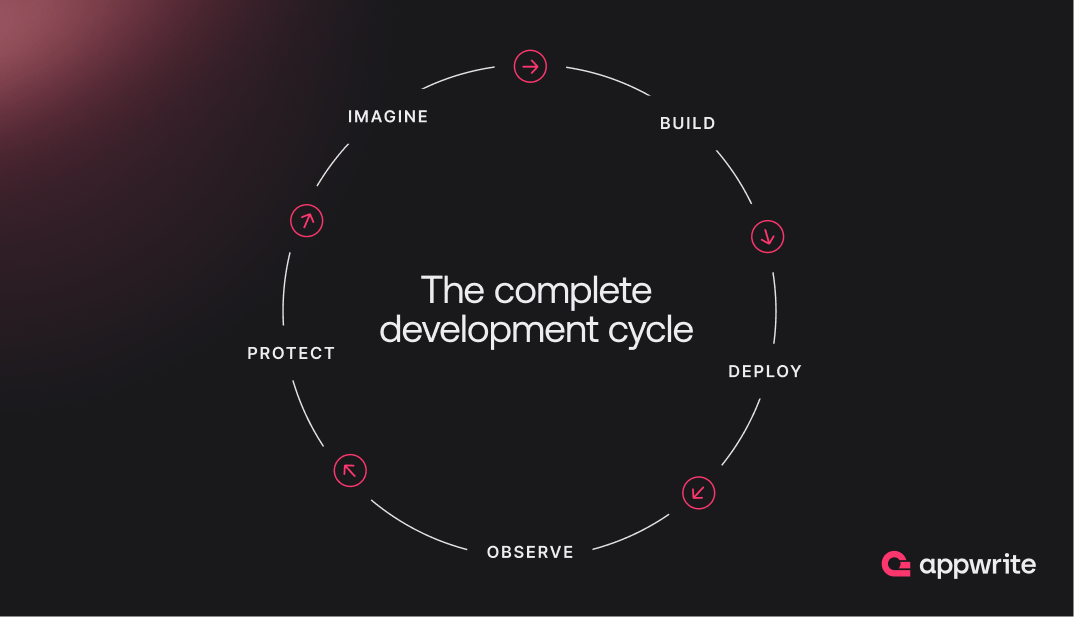
Our goal is to integrate these stages into one seamless flow. The result is a platform that reduces cognitive overhead, minimizes integration work, and allows developers to focus on shipping.
This expanding experience is what we term the developers' cloud.
A BaaS (Backend as a Service) typically stops at the API layer, requiring developers to assemble everything else. Hyperscalers operate at a much lower level, offering immense power but expecting teams to build every component themselves. The space in between – where most real products reside – has been fragmented for too long.
The developers' cloud bridges this gap. It consolidates the essential capabilities developers need, at the right level of abstraction, with a coherent experience that guides them from idea to production and beyond. It's neither too high-level to forfeit control nor too low-level to impede progress – but intentionally designed for the realities of modern software development.
Each of these stages feeds the other, creating a value loop. As you've come to expect, there is always more to come, but for now, we'll let the work speak for itself in due course. As we look ahead, we are actively expanding the edges of this lifecycle, particularly around how developers initiate new ideas and how they understand and operate their products as they grow.
Why This Matters
Modern product development is cyclical. Teams build, deploy, observe, refine, and repeat, with each stage informing the next. The most effective platforms support this entire loop consistently and transparently.
By evolving Appwrite into a complete end-to-end platform, we are creating an environment where developers can build, deploy, and grow without switching tools or losing context. This shortens feedback loops, encourages rapid iteration, and keeps the entire product lifecycle close to the developer.
This evolution remains true to the core principles that shaped Appwrite from the beginning: flexibility, openness, and developer-centric design – now extended across the entire lifecycle.
As this vision expands, we are also considering how to make the earliest steps of building more accessible. There's significant opportunity to help more individuals transform ideas into working products faster, while still maintaining developers at the heart of the platform. Some of this work is already underway.
Integrating AI Thoughtfully
It is impossible to discuss the future of software without acknowledging AI. However, we are also aware of the industry's genuine fatigue regarding overused terms, exaggerated promises, and AI often becoming a layer of hype rather than tangible value.
Our perspective is straightforward: AI is a tool designed to enhance developer productivity, not replace the craftsmanship inherent in their work. We utilize AI internally to accelerate progress, automate repetitive tasks, and help teams explore solutions more efficiently – always with human oversight. We apply it where it genuinely improves quality and reduces friction, not where it adds noise. This philosophy will continue to guide how we integrate AI into the platform.
From a product standpoint, our focus is on flexibility and integration over hype. As part of Appwrite's ongoing evolution of its database capabilities, we are expanding the tools available to developers building AI-powered applications. This includes adding a built-in vector store to Appwrite, enhancing how AI models integrate with Appwrite Functions, and streamlining the path toward complete, reliable RAG (Retrieval-Augmented Generation) workflows across various LLM providers.
We are also working to simplify the creation of persistent, agent-driven applications using Appwrite Functions in conjunction with Appwrite Realtime. This pattern already powers long-running, event-aware systems built on Appwrite today. Our current focus is on making this experience more accessible, improving the knowledge base and tooling around it, and refining workflows so developers can build real-time, LLM-enabled applications with less friction.
All this work adheres to Appwrite's defining principles: predictable performance, strong defaults, and a developer experience that remains coherent as the platform grows. AI should augment how you build and operate your applications, not introduce new friction. That is the standard we are committed to building for.
How We Build
As our scope expands, so does our responsibility to build with depth and intention. To support this evolution, we operate through cross-functional product teams. Each team owns a vertical end-to-end, combining engineering, product, design, and operations to deeply focus on quality and developer experience.
Cross-functional ownership grants teams autonomy and speed, but it also presents new challenges. When multiple teams progress in parallel, maintaining shared standards, aligning on design principles, and ensuring a consistent developer experience across products becomes more difficult. Without proper structure, interfaces can diverge and lose coherence.
To address these challenges, we balance vertical product teams with functional chapters. Chapters bring together experts from across teams in engineering, product, and design to maintain robust communication, shared standards, and a unified perspective. They ensure that using one Appwrite product feels familiar when transitioning to another. APIs align, workflows behave consistently, and the platform feels cohesive and intentional.
This structure enables us to move with urgency while safeguarding the most critical details: reliable scaling, predictable performance, thoughtful APIs, transparent pricing, secure defaults, and intuitive workflows.
Every stage of the developer journey demands specialization. We take that seriously.
What Comes Next
Appwrite will continue to deliver the backend building blocks and deployment tools you rely on. Concurrently, Sites and the upcoming stages of Imagine, Observe, and Protect will broaden how developers interact with their projects in production, offering greater visibility, control, and confidence as you scale.
You will also see us further explore new layers of flexibility, particularly in how developers connect and manage their data. We are working on something that will push our vision even further, and we will share more details when it is ready.
This is not a single release, but a long-term evolution guided by the same mission that has always defined Appwrite: empowering developers to create, innovate, and succeed at scale with a platform that grows alongside them.
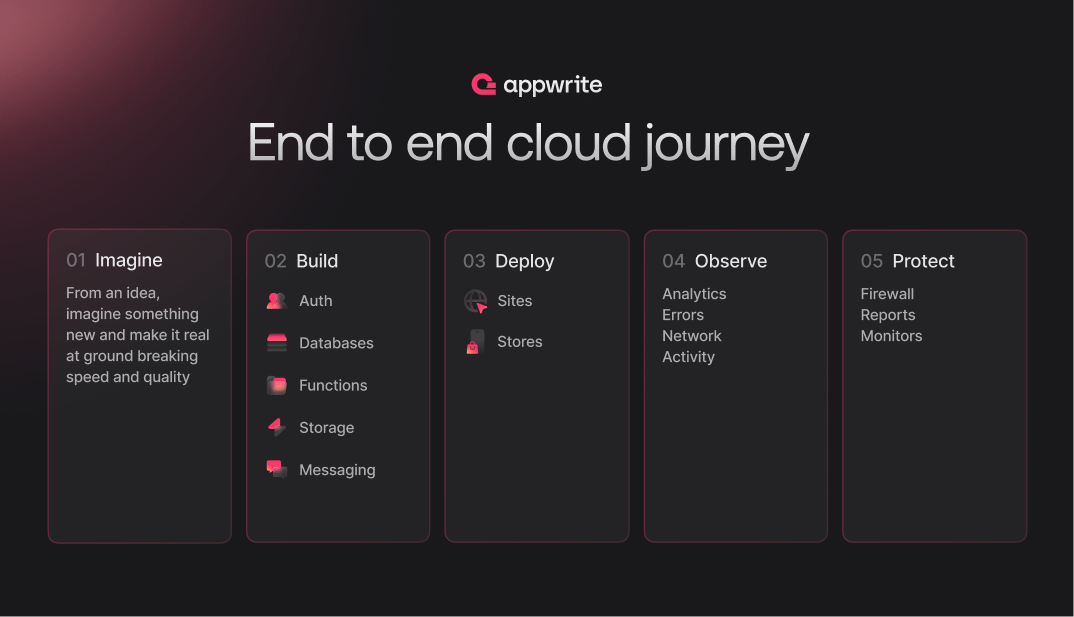
As these components converge, Appwrite transforms into not just where you build, but where your product lives and scales. One platform. Consistent experience. Full lifecycle.
This is the future we are building toward. And this is just the beginning.