Introducing Zensical: The Next-Gen Static Site Generator by Material for MkDocs Creators
Introducing Zensical: A next-gen static site generator from Material for MkDocs creators. Enjoy 5x faster rebuilds, modern design, and blazing-fast search for documentation.
We are thrilled to announce Zensical, our next-generation static site generator (SSG) meticulously designed to simplify and enhance the process of building documentation sites. Distilled from a decade of experience, Zensical represents our dedicated effort to overcome the technical limitations of MkDocs, extending far beyond its capabilities.
Zensical is the culmination of thousands of hours of work—built from the ground up to provide a modern and comfortable authoring experience. It also makes it easy for developers to extend and customize through its upcoming module system. Our goal is to support docs-as-code workflows involving tens of thousands of pages, without compromising performance or usability.
To ensure a seamless transition, compatibility is paramount. We are investing significant effort into guaranteeing a smooth migration from Material for MkDocs for all users. Zensical can natively read your mkdocs.yml configurations, allowing you to build your existing projects with minimal changes. Currently, a subset of plugins is supported, and we are actively working towards full feature parity in the coming months.
Zensical is fully Open Source, licensed under MIT, and can be used for any purpose, including commercial applications. We are also transitioning away from our sponsorware model, replacing it with our new offering for professional users: Zensical Spark. This strategic shift allows us to maintain independence, maximizing user value as we shape the future of Zensical collaboratively with you.
You can subscribe to our newsletter to stay informed.
This article is the second in a four-part series:
- Transforming Material for MkDocs
- Zensical – A modern static site generator built by the creators of Material for MkDocs (You are here)
- Material for MkDocs Insiders – Now free for everyone
- Goodbye, GitHub Discussions
Why Zensical?
Since its initial release in 2016, Material for MkDocs has empowered tens of thousands of teams to publish and maintain reliable documentation. However, in recent years, we've encountered significant limitations within our core dependency, MkDocs. These limitations proved impossible to overcome due to their deep roots in its architecture.
As mentioned in our update on our foundational work, MkDocs must now be considered a supply chain risk, having been unmaintained since August 2024. It has seen no releases in over a year and continues to accumulate unresolved issues and pull requests. These developments compelled us to sever our ties with MkDocs as a dependency.
To chart a new course, we returned to the drawing board, consulted with dozens of our professional users, and thoroughly analyzed the MkDocs ecosystem. Our aim was not merely to create a fork or port of MkDocs, but to fundamentally rethink static site generation from first principles.
With Zensical, we are building a modern static site generator that is compatible with your existing content and customizations, while directly addressing MkDocs' limitations. While Material for MkDocs was built on top of MkDocs, Zensical consolidates both projects into one coherent stack, encompassing static site generation, theming, and customization. Here’s what you can expect today:
- 5x faster rebuilds
- Modern design
- Blazing-fast search
Although we haven't yet achieved full feature parity, you can already use Zensical to build your existing Material for MkDocs projects with minimal changes.
You can jump to the compatibility section to learn what is already supported.
What you can expect
Solid foundation
Our goal with Zensical is to create a coherent and modern stack, vertically integrating all aspects of the authoring experience (AX), developer experience (DX), and user experience (UX). This provides us with a significant competitive advantage over solutions that overly rely on third-party frameworks and dependencies, helping us to create much more robust Open Source software.
ZRX, our new differential build engine, forms Zensical's solid foundation and is an Open Source project in its own right. It represents a fresh approach to making differential data flows easy to build and enjoyable to work with. Most engineering effort has been invested in ZRX, as it forms the backbone of Zensical and will enable us to ship features faster.
Following the principle of architectural hoisting, we moved essential, reusable functionality into ZRX, which allows us to keep Zensical's core simple and focused on static site generation. ZRX handles the heavy lifting—differential builds, caching, and data flow orchestration.
With the upcoming module system and component system, both of which are on our public roadmap, Zensical will gain more degrees of freedom in the coming months, allowing you to extend and customize it in ways that were previously impossible with MkDocs.
Modern design
Zensical introduces a fresh, modern design that moves beyond the Material Design aesthetic, establishing a visual foundation that is more easily brandable and adaptable to diverse use cases. The new design prioritizes clarity, simplicity, and usability, while presenting a more professional finish:
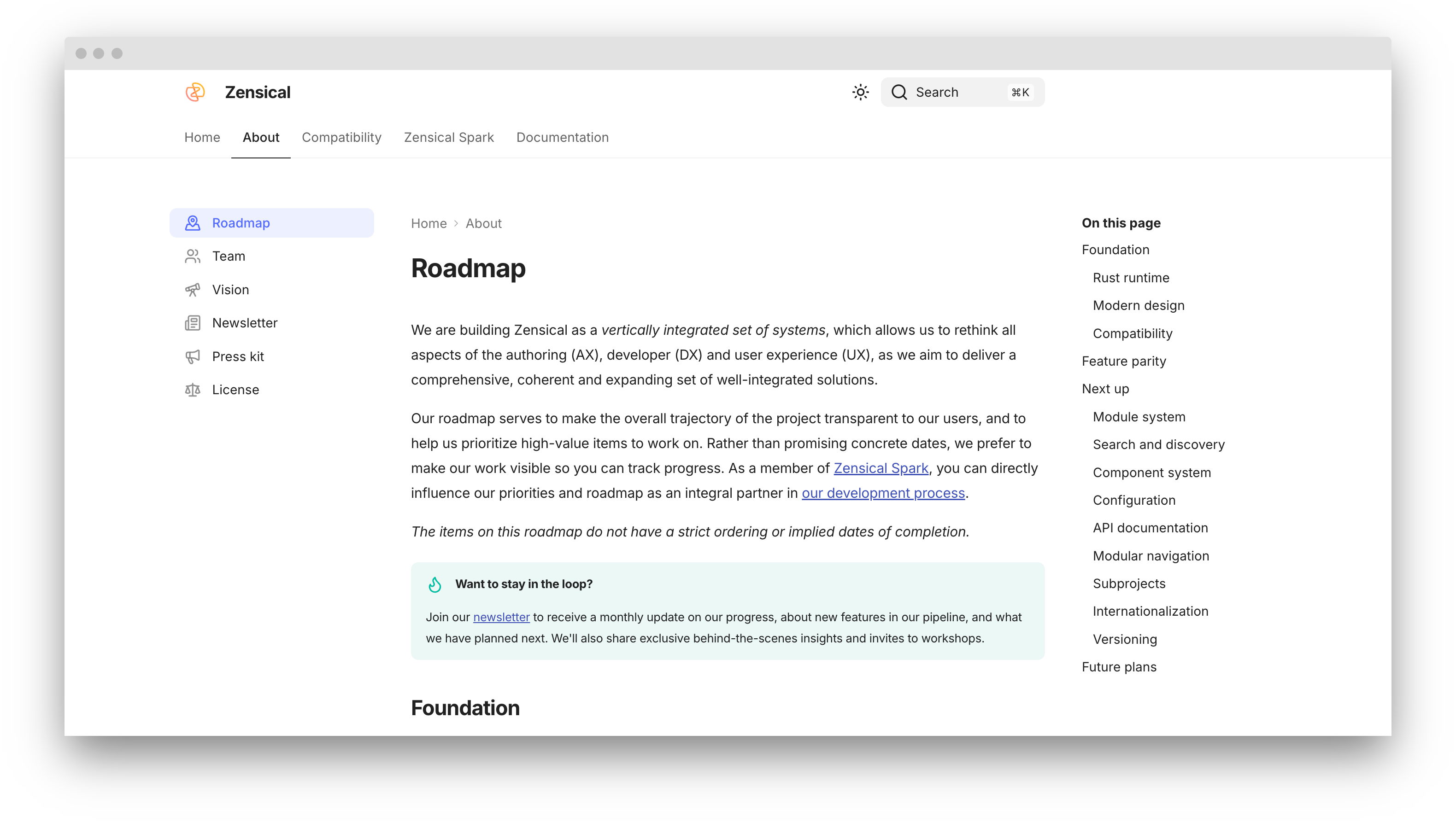
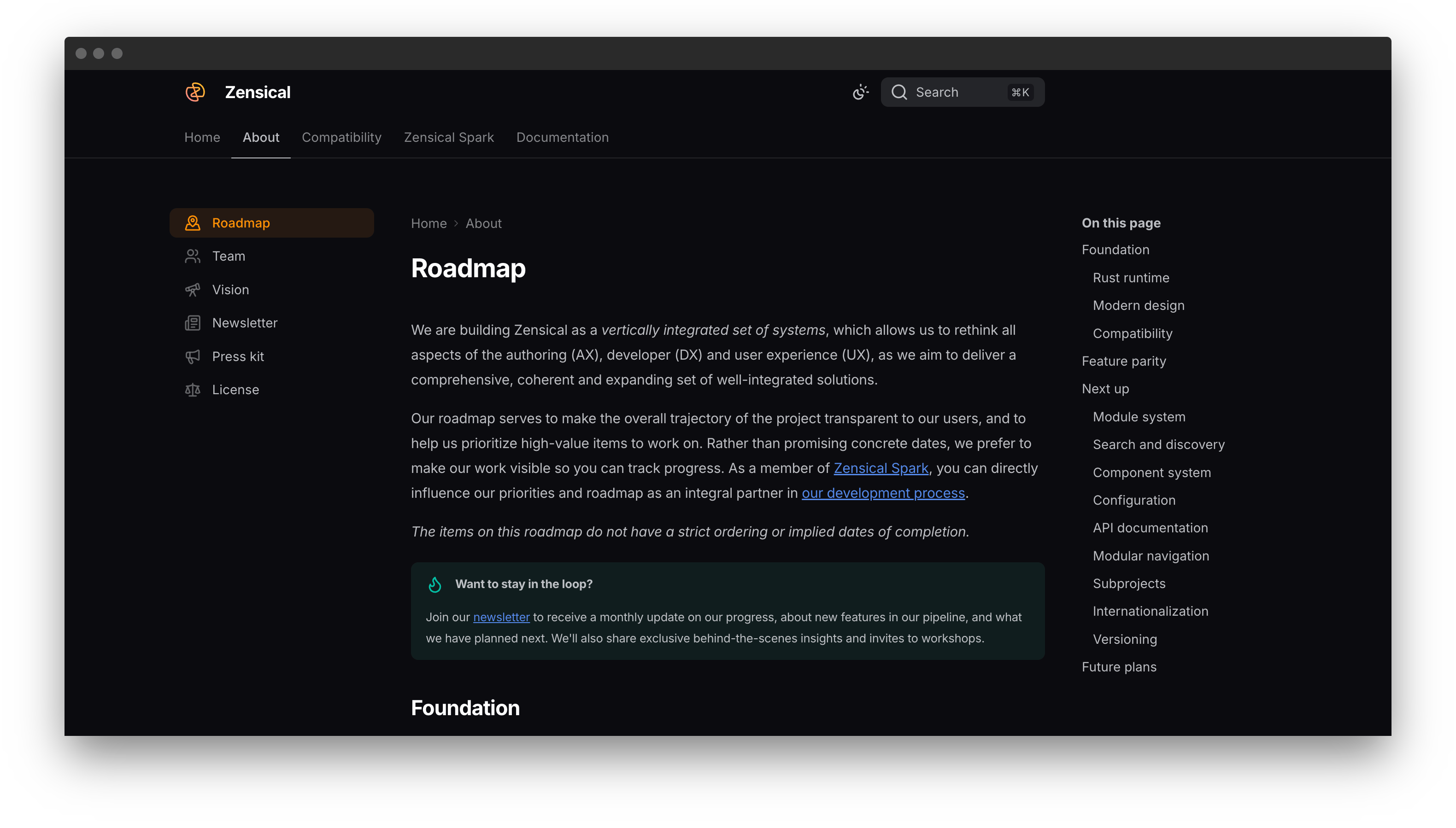
Our public roadmap, built with Zensical, showcases its capabilities.
Right now, Zensical's layout and site structure closely match Material for MkDocs, as we are prioritizing maximum compatibility. Once we complete work on our upcoming component system, we will provide an alternative that is much more flexible and adaptable, easily tailored to different use cases and branding requirements.
You can also retain the Material for MkDocs look and feel with a single line of configuration.
Blazing-fast search
Client-side search isn't a compromise—for the vast majority of static sites, it's the optimal solution, offering superior speed, zero maintenance, and no service fees.
As covered in depth in the first part of this series, the current search implementation in Material for MkDocs has severe limitations and is based on a now-unmaintained library. This led us to build a new search engine from scratch, based on the same core goals as Zensical itself: performance, flexibility, and extensibility.
Disco, our modular and blazing-fast client-side search engine, is exclusively available in Zensical. When you build your site with Zensical, your users will immediately benefit from Disco's improved ranking algorithm, as well as its advanced filtering and aggregation capabilities:

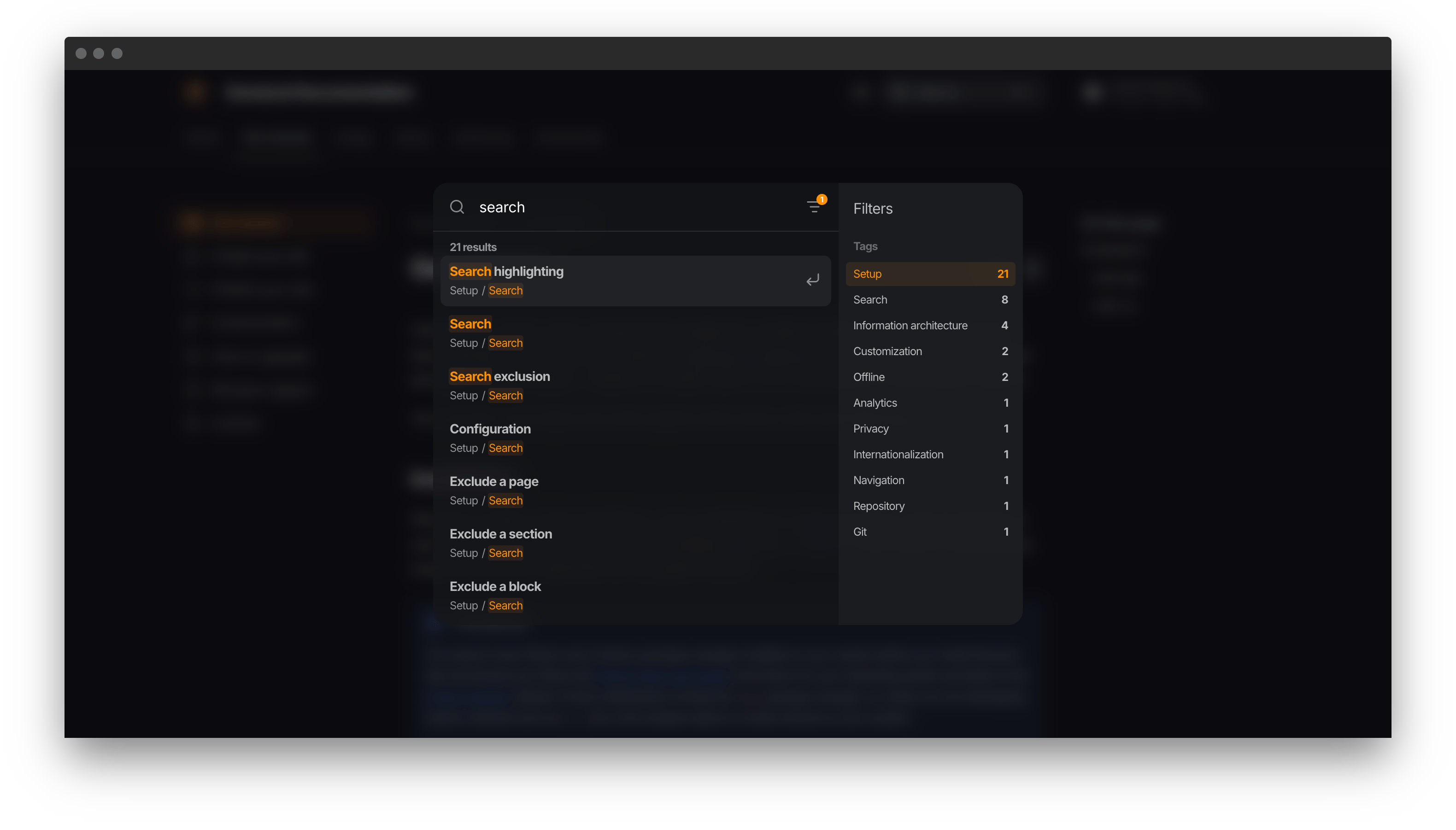
Disco is actively showcased on zensical.org.
In early 2026, we'll release Disco as a standalone Open Source project. With feedback from our professional users in Zensical Spark, we will evolve the search experience, transforming Disco into a highly configurable and customizable search engine that adapts to your specific needs.
You can subscribe to our newsletter to receive news about Disco.
Authoring experience
Slow feedback loops can be a major pain point when writing documentation. Almost all of us know the feeling of waiting for the static site generator to finish building the site, just to see a small change reflected in the output. With Zensical, we are finally addressing this issue.
It's important to understand that we are not yet utilizing the differential capabilities of ZRX to the fullest extent, as we are currently forced to make several compromises to ensure maximum compatibility with Material for MkDocs. Markdown rendering still relies on Python Markdown, which incurs extra marshalling costs.
While the initial build can sometimes be slower than with MkDocs, repeated builds—especially when serving the site—are already 4 to 5x faster, as only changed files need to be rebuilt.
We are also developing a new Markdown toolchain based on a CommonMark-compliant parser written in Rust, which will significantly accelerate Markdown processing. We'll tackle this as part of the upcoming component system, starting in early 2026. Once our new Markdown toolchain is ready, we will provide automated tools to translate between Python Markdown and CommonMark, eliminating the need for manual content migration.
Maximum compatibility
Compatibility with Material for MkDocs is our top priority. We understand that switching to a new static site generator can be challenging, particularly for large projects with extensive customizations. Therefore, we've invested significant effort to ensure that Zensical understands mkdocs.yml configuration files, allowing you to build your projects with minimal changes.
This means your existing Markdown files, template overrides, CSS, and JavaScript extensions do not need to be touched, primarily because we have not altered the generated HTML and still rely on Python Markdown for processing your content.
However, plugins present a different challenge. In MkDocs, virtually all plugins have side effects, making parallelized builds impossible. We started from first principles, asking: what should extensibility look like in a modern static site generator? Our answer is the upcoming module system, which takes a fundamentally different approach based on four core principles:
- Modules can inject, extend, and redefine functionality.
- Modules are deterministic through topological ordering.
- Modules foster reusability, with the possibility to remix them.
- Modules can cooperate through well-defined contracts.
We are working to ship essential functionality, currently provided by MkDocs plugins, as built-in modules. In early 2026, we will open the module system to third-party developers, enabling them to build their own modules, as we envision Zensical at the heart of a thriving ecosystem.
Zensical Spark
Zensical Spark, our offering for professionals, is the result of countless conversations with professional users of Material for MkDocs. From startups to large enterprises, we empower organizations to realize complex projects in diverse environments. To achieve this, we've created Zensical Spark as a collaborative space. If you're a professional user, Zensical Spark is designed for you, because:
- You can be confident that Zensical will continue to be developed and maintained long-term as a set of interconnected and sustainable OSI-compliant Open Source projects.
- You can receive the support you need to successfully use, configure, and customize Zensical within your organization, receiving first-class support from the Zensical team.
- You can influence the future development of Zensical by participating in our new approach to Open Source software development, helping us to build exactly what you need.
Let's talk! If you're working in a professional context, reach out to hello@zensical.org to schedule a call and learn how Zensical Spark enables your team to transition to Zensical smoothly and have a voice in its continued development.
You should also consider joining the waiting list, as seats are limited.
We're growing our team
We're also excited to announce that we're growing our team:
Timothée Mazzucotelli, also known as @pawamoy, is joining Zensical!
At Zensical, Tim will focus on providing the same seamless experience for generating API reference documentation from source code (via docstrings) as he has done with mkdocstrings, the second biggest project in the MkDocs ecosystem. With his expertise and Zensical's new stack, we'll be pushing the boundaries of what's possible with API reference documentation.
Goodbye, GitHub Sponsors
Thank you! To all of you who have supported us over the years through GitHub Sponsors—we are incredibly grateful for your support. It has been invaluable in helping us to build, maintain, and evolve Material for MkDocs, and we couldn't have done it without you.
Seriously, thank you!
Material for MkDocs gave us something invaluable: experience building for tens of thousands of users, and the opportunity to build a team around Open Source software. It showed us that making a living from Open Source isn't just possible—we grew it into one of the largest sponsorware projects on GitHub and inspired others to pursue similar paths.
Now we're breaking new ground. Zensical is our next chapter, and we're professionalizing how we approach Open Source development. Our vision is to make Zensical free for everyone to use while building a sustainable business around it through our new approach.
This transition means saying goodbye to GitHub Sponsors. It has served us exceptionally well, but as we professionalize and scale, we're making the leap from personal project to company—building a business and team that can meet the growing demands of professional users while staying true to our values.
We're doubling down on Open Source, developing software for everyone.
If you want to continue supporting our work, please subscribe to our newsletter. We'll be providing new methods to support us in the coming months, with the possibility of getting exclusive goodies.
Looking Ahead
Material for MkDocs grew organically in a pot that eventually became too small. With Zensical, we're building on solid foundations designed to grow with us—and with you.
Material for MkDocs is now in maintenance mode
We want to be transparent about the risks of continuing to use Material for MkDocs. With MkDocs unmaintained and facing fundamental supply chain concerns, we cannot guarantee Material for MkDocs will continue working reliably in the future. We're aware that transitioning takes time, which is why we commit to supporting it for at least the next 12 months, fixing critical bugs and security vulnerabilities as needed, but the clear path forward is with Zensical.
If documentation plays a critical role in your organization, and you're concerned about how this might affect your business, consider joining Zensical Spark, or feel free to schedule a call by reaching out at hello@zensical.org.
Where we'll be in 12 months
Over the next 12 months, following our phased transition strategy, we'll reach Phase 2 and 3—introducing our module system and component system, as well as CommonMark support. By replacing Python Markdown with a Rust-based Markdown parser, we'll unlock significant performance improvements and the modularity needed for flexible templating. This is where Zensical truly starts to unfold its capabilities.
Zensical is already powering real projects due to its extensive compatibility with Material for MkDocs. We're actively working on closing the gap to reach full feature parity.
You can install Zensical now, and build your existing Material for MkDocs projects with it. If you run into a bug, please don't hesitate to open an issue—we're here to help.
Connect with us
If you have questions we haven't addressed, please reach out to us at hello@zensical.org. We're currently collecting questions from the community about Zensical and will address them in an FAQ section as part of our documentation in the coming weeks.
We're incredibly thankful that you have been part of our journey so far. With Zensical, we're embarking on a new chapter, and we couldn't be more excited to have you with us.
You can subscribe to our newsletter to stay in the loop.
2025-12-08
2025-11-05
