Mastering Uncertainty: The Two Critical Types and a Costly Leadership Mistake
Discover the two distinct types of uncertainty – execution and transformation – and how misapplying planning or experimentation can lead to significant project failures and wasted resources. Learn a crucial question that can save years of effort.
I once spent nearly a year building something nobody needed. This wasn't due to a lack of talent or resources within my team; we had both. Our failure stemmed from solving the wrong problem with an incorrect approach, a realization that came far too late.
I ultimately had to cancel the project and reassign my team. Facing those who had invested so much effort and informing them of our decision to abandon the work was a profound moment. It fundamentally reshaped my approach to leadership, and I've reflected extensively on its lessons ever since.
Where We Went Wrong
We identified a genuine opportunity and a problem to solve. We meticulously planned, designed, and architected a system for beautiful scalability. Our intense focus on building it right prevented us from pausing to truly ascertain if we were building the right thing. The market shifted significantly during our heads-down development, and the need we designed for had changed by the time we launched.
There's a unique sting when a highly anticipated launch is met with indifference. We had created an excellent system, but for a problem that no longer aligned with market realities.
This kind of failure isn't merely a drain on time and resources; it takes a deeper toll. I questioned my judgment and wondered if I had let my team down by projecting certainty in the wrong direction. The lesson, once finally grasped, was obvious, though it took me too long to arrive at it.
The Two Types of Uncertainty
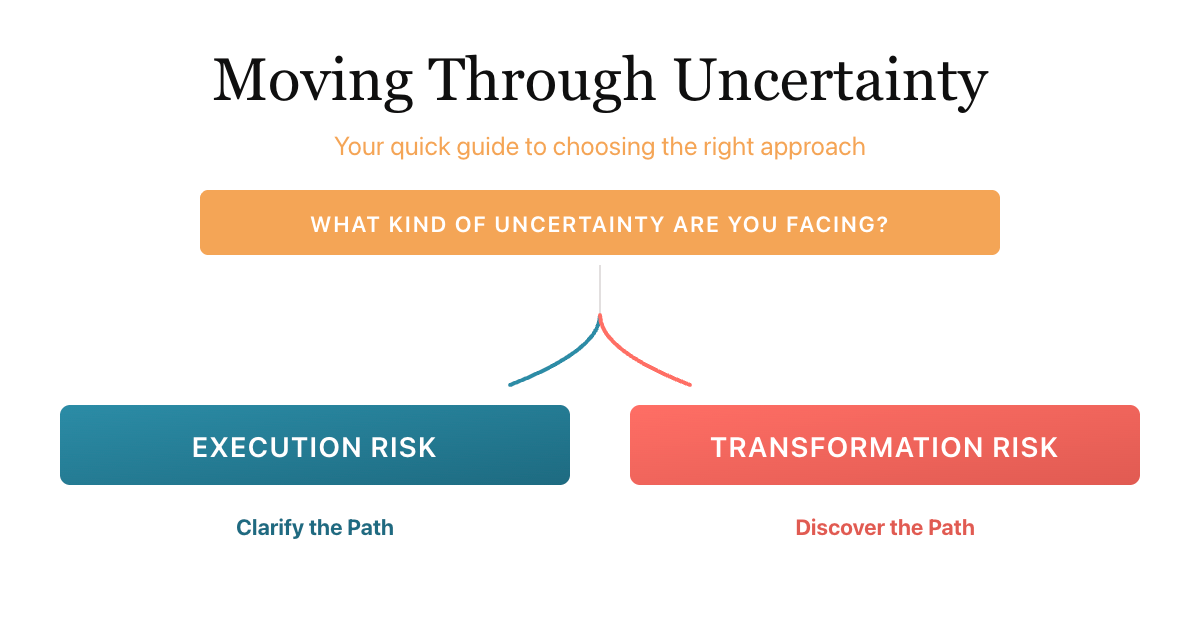
There are two distinct types of uncertainty, each demanding a fundamentally different response. This understanding transformed my leadership philosophy.
1. Execution Uncertainty
With execution uncertainty, your destination is clear. You know precisely where you're going. The ambiguity lies in the path to get there—the obstacles, dependencies, and risks along the way. When confronted with execution uncertainty, the correct approach is to plan. Break down the work, sequence tasks, remove blockers, coordinate across teams, and drive forward.
2. Transformation Uncertainty
In contrast, with transformation uncertainty, the destination itself is unclear. You don't actually know where you're going. You're uncertain about customer needs, market demands, or even if your proposed solution will ultimately be relevant. For transformation uncertainty, extensive planning is counterproductive. The right move is to experiment. Place small bets, implement tight feedback loops, and prioritize learning before committing to significant builds.
My observation is that most leaders instinctively default to planning, even when facing transformation uncertainty. Why? Because planning feels like leadership. It conveys decisiveness, involves allocating resources, setting timelines, and creates visible progress. However, planning through transformation uncertainty often leads to the predicament I faced: brilliantly executing towards a destination nobody needs you to reach.
The Difficulty of Internal Recognition
I want to be candid: even with this knowledge, embracing experimentation remains challenging for me. I prefer clarity, a clear vision, and a direct path to achievement. Experimentation feels slower, less certain, and, frankly, it's rarely my immediate inclination. My instinct is often to think big and launch quickly.
However, experimentation doesn't equate to thinking small. You still require shared understanding and a clear 'why' to orient the team. The crucial difference is that you are testing your way towards the 'what,' rather than assuming you already know it.
There's a reassuring comfort in declaring, "Here's the plan, let's go." Conversely, admitting "we don't know yet—let's find out" can be daunting. Yet, false clarity is far more perilous than honest uncertainty. Confident misdirection is not leadership; it's an expensive form of avoidance. The most effective leaders I've collaborated with have mastered the discomfort of not knowing. They understand that "I'm not sure—let's test it" can sometimes be the most powerful statement a leader can make.
A Simple Question That Could Have Saved a Year
Looking back, one question could have made all the difference: "What would have to be true for this to matter?"
This isn't "how do we build this well?"—that's an execution question. Instead, it probes: "What are our assumptions about the market, the customer, and the need? And how quickly can we test those assumptions before committing fully?"
Had I asked this question six months earlier, we might have initiated small experiments instead of embarking on a major rewrite. We could have detected the shifting landscape before investing a year into building a system on unstable ground. The project would still have presented challenges, but the failure would not have been nearly as costly, and a year of dedicated effort would not have been wasted.
Key Takeaways
Before you commit to a plan, always ask: Do we actually know where we’re going?
- If the answer is yes—if success can be clearly defined, and the primary question is how to achieve it—then plan effectively and execute swiftly.
- If the answer is ambiguous—if you're unsure what success looks like or whether your solution will truly matter—resist the urge to over-plan. Instead, experiment, learn, and stay closely attuned to real market signals.
The cost of misjudging this can be months or years spent pursuing the wrong direction. The reward for getting it right is a team that builds solutions that genuinely matter, led by an individual honest enough to admit when they don't have all the answers yet.
I am continually learning this lesson, and I expect to be for the foreseeable future. However, I prefer to lead with honest uncertainty rather than confident misdirection, and I'd rather learn this lesson the hard way once than repeat the same costly mistake.