Mastering Your Life with a Personal Knowledge Management Workflow
Unlock mental clarity and a deeper life with a comprehensive Personal Knowledge Management (PKM) workflow. This guide explores building a Second Brain, Zettelkasten, GTD, minimalism, and stoicism to reduce stress, boost creativity, and enhance overall well-being.
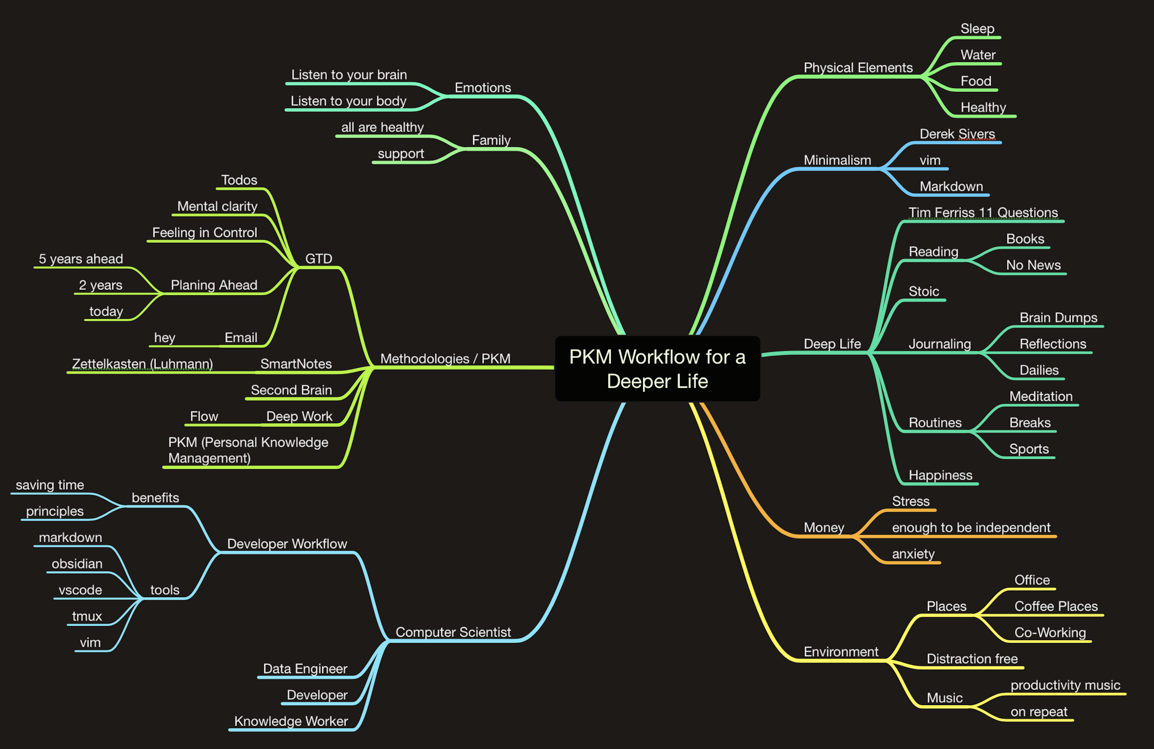
In an era of widespread burnout and mental stress, a robust Personal Knowledge Management (PKM) system has become indispensable. Our capacity to recall information is limited, especially when juggling personal responsibilities, professional demands, and creative endeavors. A PKM system, often conceptualized as a "Second Brain," offers a sustainable method to store and manage this vast information. This approach significantly reduces stress and enhances mental well-being by externalizing memory, fostering creativity through interconnected ideas, and organically integrating tasks and future plans. Cultivating a "deep life" is a natural outcome of continuous learning and reflection facilitated by such a system.
How It Started: The Path to Minimalism
Surprisingly, my journey into Personal Knowledge Management began with learning vim. Despite its steep learning curve, the vim philosophy and language became pervasive in my digital life. I integrated Vimium for Chrome, vsvim for VS Code, and adopted plain text notes for blogging and writing. The distraction-free environment of a terminal, devoid of graphical clutter, fostered unparalleled mental clarity—akin to a meditative state.
Markdown served a similar purpose for note formatting, offering plain text with structured elements. This liberated my notes from proprietary formats, ensuring full ownership and accessibility.
Significant inspiration also came from Derek Sivers and insights from the Tim Ferriss Podcast. Sivers' minimalist approach to writing and life—stripping sentences to their essence and removing unnecessary digital elements (like unused HTML tags or <div> blocks from websites)—profoundly influenced my perspective. This adherence to minimalism, with its emphasis on less clutter, provides clarity and greater freedom, laying the groundwork for my PKM workflow.
Subsequently, I integrated various methodologies from books and podcasts into this workflow, allowing my cognitive energy to be directed towards creative thought and problem-solving.
The PKM System
A Personal Knowledge Management (PKM) workflow is crucial for individuals, developers, and knowledge workers alike. It offers a transformative way to capture knowledge and manage tasks, significantly reducing stress and enhancing overall quality of life.
Smart Note Taking
To begin, mastering 'Smart Notes' is fundamental. Without this strategic approach, your system risks becoming cluttered, leading to disorganization and increased stress. To achieve mental tranquility, it's vital to offload thoughts from your mind into an external system. This can be achieved by freely dumping ideas into a blank file—a method akin to journaling—or through general note-taking.
A core principle, championed by Sönke Ahrens in his book 'How to Take Smart Notes,' states that writing is not merely the outcome of thinking; it is the medium in which thought occurs. Instead of facing a blank page when developing an idea or blog post, which often leads to procrastination, Smart Note Taking encourages writing smaller, interconnected notes within your Second Brain. This process transforms brainstorming into an organic generation of new ideas by linking existing thoughts.
Life's projects rarely unfold sequentially. Smart Note Taking facilitates working on multiple projects and ideas concurrently by documenting the current state of your thoughts. This ensures you can seamlessly resume work without fear of forgetting details, addressing the myriad personal, work, and family responsibilities that demand mental clarity.
Crucially, the brain often struggles to rest until a task is complete. However, it doesn't distinguish between a task being 'finished' or 'written down.' Therefore, the act of writing tasks down, a central tenet of 'Getting Things Done' (GTD), allows your mind to relax.
Effective note-taking also requires an open mind, actively seeking out and challenging existing knowledge with opposing viewpoints. This intellectual curiosity refines both writing and thinking abilities.
Consider the difficulty of recalling seven random numbers versus recalling numbers linked to significant events, like football World Cup years. This illustrates the power of connection, which is why Smart Notes are designed to be interlinked, elevating them through methods like the Zettelkasten (discussed further below).
Nick Milo aptly rephrases 'note-taking' as 'note-making,' emphasizing the active cognitive process involved beyond mere capture. For deeper insights, refer to Sönke Ahrens' book or Tiago Forte's summary.
Writing is Thinking
Remember: Writing fundamentally is thinking. Without the act of writing, genuine thought and progress are often stifled. The more you write and take notes, the more proficient a thinker you become, which in turn enhances your reading comprehension by fostering better questions.
The Second Brain
Once smart note-taking is mastered, the next step is integrating it into a sustainable system. The 'Second Brain' methodology, popularized by Tiago Forte, offers an ideal framework. While I had been taking notes for over a decade, storing them in tools like Microsoft OneNote, understanding them as a 'second brain' fundamentally shifted my approach. This mental model encouraged me to capture valuable information I previously overlooked, such as health details from doctor visits, knowing I could connect these dots later.
A Second Brain is essentially a methodology for systematically saving and recalling ideas, inspirations, insights, and connections gathered through personal experience. It leverages modern technology and networks to extend our memory and intellect, not just preserving ideas but transforming them into actionable reality. It establishes an external, centralized digital repository for learned information and its sources. (For comprehensive details, Tiago Forte's work on B.A.S.B. is recommended).
Inspired by this, I transitioned my traditional folder-based notes to the P.A.R.A. (Projects, Areas, Resources, Archive) folder structure. Forte suggests that our brains are not designed to manage infinite nested folders, so PARA limits the system to no more than four levels deep. Below is an example of a PARA-structured Second Brain:
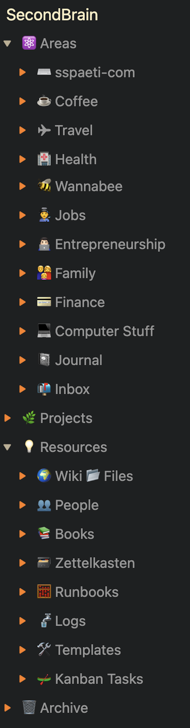
Obsidian Folder Structure with PARA.
While there's no single 'right' way, the goal is to find what works best for your cognitive style. (For implementation guidance, systematic mastery resources by Zowie are available).
Key benefits of a Second Brain include:
- Ubiquitous Knowledge: It transforms your knowledge into a portable, accessible extension of your physical self.
- Pattern Discovery: It helps uncover unexpected connections between ideas as you write and manipulate your thoughts.
- Stress Reduction: It alleviates stress and information overload by fostering trust in your organized system.
- Expertise Development: It cultivates valuable expertise, specialized knowledge, and skills that benefit personal life, career, and business ventures.
- Knowledge Cultivation: It allows for the gradual accumulation of valuable insights without rigid, time-consuming rules.
Only Keep What Resonates
Crucially, only retain information in your Second Brain that genuinely resonates with you. Avoid direct copy-pasting from the internet. Instead, link to original sources and summarize content in your own words. Always create notes with your future self in mind. While copying extensive text might seem harmless initially, it will eventually clutter your system and diminish its utility. Frame all linked notes as your own thoughts, enabling instant recall and effortless connection to other ideas. This mimics the brain's natural associative processes, making the system intuitive.
The upcoming section will explore the Zettelkasten method, which, while sometimes conflated with a Second Brain, is distinct. I'll explain its principles and how I've integrated it as a dedicated folder within my system.
Multiple Second Brains
It's worth noting that other digital tools, such as Google Contacts, password managers, and email clients, also function as forms of 'second brains,' demonstrating that you don't need to limit yourself to a single system.
Zettelkasten
Having touched upon the Zettelkasten method in the context of the Second Brain, let's delve deeper into this system, pioneered by Niklas Luhmann and often referred to as the 'Slip Box.' This approach liberates note-takers from the traditional 'librarian's mindset' of organizing information into rigid main and sub-categories. Instead, it advocates for focusing on individual thoughts as distinct notes. Rather than expending mental energy on folder placement, all notes are created in a single location and interconnected. While a pure Zettelkasten typically lacks an overarching structure, I've integrated it into my Second Brain with a dedicated folder, visible in the 💡 Resources/🗃️ Zettelkasten section of the folder structure shown previously.
The Zettelkasten method is a personal strategy for thinking and writing. Similar to a Second Brain, it combats daily information overload, not only by storing and organizing knowledge but also by enhancing memory and retention. It's ideal for systematically organizing crucial information, ensuring its retrievability years later, and fostering the development of new ideas.
Within the Zettelkasten, three primary note types exist:
-
Fleeting Notes: These are quick, informal jottings of any thought or idea that spontaneously arises. They are not meant to be highly organized or detailed but serve as temporary reminders.
-
Literature Notes: Niklas Luhmann created these on index cards, including bibliographic details. Each card captured a key point he wished to remember or potentially use in his writing. Sönke Ahrens provides four guidelines for creating literature notes:
- Be highly selective in what you choose to keep.
- Keep the note as concise as possible.
- Use your own words rather than verbatim copying.
- Record the bibliographic details of the source.
-
Permanent Notes: These are the most critical, forming the long-term knowledge base that gives the Zettelkasten its enduring value. Created by reviewing fleeting and literature notes, permanent notes are refined and linked to existing topics within your Zettelkasten, reflecting your research, current thinking, and interests. The objective extends beyond mere collection; it's about developing arguments and fostering ongoing discussions over time. Engaging with your Zettelkasten through open-ended questions can deepen your thinking and push intellectual boundaries.
Deleting Fleeting Notes After Rewriting
Once ideas from fleeting notes are rewritten into permanent notes, the fleeting notes should be discarded. Literature notes, after being processed, are filed into your bibliographic Zettelkasten.
This method requires adaptation, and I continue to refine my approach. However, the power is already evident. I now direct most notes to my Zettelkasten folder, reserving the ⚛️ Areas folder for recurring themes like family, health, and work, and the ✉️ Inbox for initial captures before proper processing. This significantly reduces decision fatigue, allowing me to focus on content. It also provides a sense of calm, knowing that quickly jotted thoughts will be organically rediscovered when needed or during periodic reviews of my inbox, often sparking new connections and ideas.
Tool of Choice
I utilize Obsidian for establishing these interconnected thoughts within my Zettelkasten.
Getting Things Done (GTD)
While previous sections focused on managing ideas and knowledge within a Second Brain, a significant source of anxiety and stress stems from an overwhelming number of unmanaged tasks, responsibilities, and aspirations. Despite attempts to integrate to-dos into note-taking apps, a dedicated tool and workflow have proven most effective. After exploring various apps—including Wunderlist, Remember the Milk, Any.do, Todoist, Trello, Simple List, Google Tasks, and Microsoft Todo—I found none provided the underlying methodology I needed. This changed with David Allen's book, 'Getting Things Done' (GTD).
The GTD framework begins with two simple, yet powerful, steps:
- Ask yourself: "What’s the next action?"
- Immediately complete any task that takes less than two minutes.
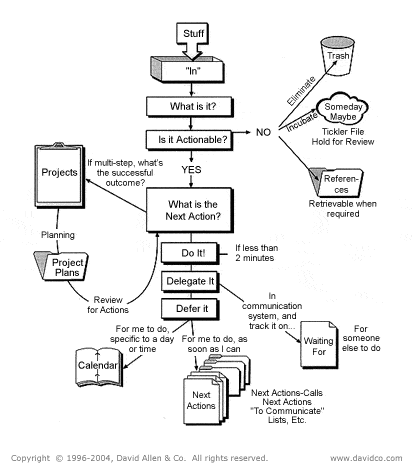
Overview of the steps in the GTD Workflow (Source: Lifehack)
A crucial distinction in GTD is separating task capture (adding to an inbox) from task review (asking the "next action" question). This allows for rapid input without distraction during capture, reserving a different cognitive mode for deeper thought during review—or immediate action for quick tasks. Many overlook this, often listing vague items like "do tax" or "change tires." GTD encourages actionable tasks, such as "call accountant for a date," "collect payslip," or "call garage for appointment." Such specific tasks are less stressful and more readily accomplished, preventing them from languishing in a to-do list for months.
Further critical elements include organizing 'next actions' into distinct lists: 'Next,' 'Waiting,' 'Scheduled,' or 'Someday/Maybe.' Incorporating tags like #calls or #atcomputer enables powerful filtering, allowing you to batch tasks by physical location. Additional filters, such as energy level (low, medium, high), facilitate task selection based on your current state, while categorizing tasks by project (personal/work) helps quickly locate relevant items.
An example of this in an application like NirvanaHQ illustrates how properties can be assigned when creating a new to-do:
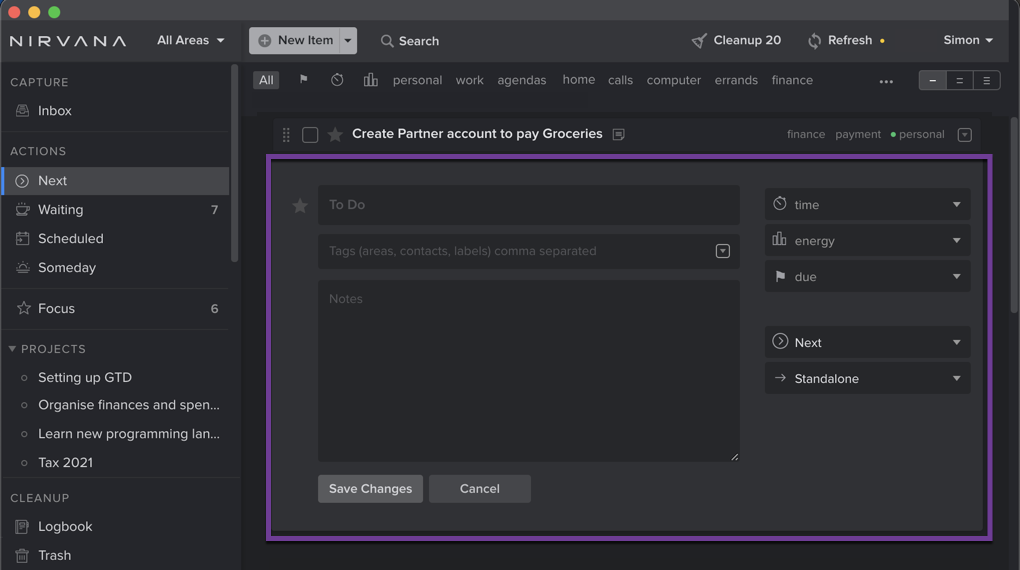
Properties when creating a new To-Do in Nirvana (Image by the Author)
The GTD method is extensive, encompassing five steps from 'capturing' to 'engaging,' and integrating higher-level goals. Reading the full book is highly recommended for its potential to significantly impact your life. NirvanaHQ, in my experience, implements this method most effectively due to its distraction-free design, lacking calendar integrations, image uploads, or excessive emojis.
Ultimately, the human brain is not optimized for storage and recall. The overarching goal is to externalize everything into a trusted system. The act of writing tasks down brings relief, but the continuous challenge is maintaining system trust. If you doubt its reliability, your brain will revert to trying to remember everything.
Trigger Events
Calendars can also house future to-dos. Instead of cluttering your task manager with distant tasks, place important trigger events on your calendar, adding them to your task list only when they become relevant. A trusted calendar is as vital as a trusted to-do app.
Six Horizons of Focus
Integrating the 'Six Horizons of Focus' into your projects and tasks ensures that your 2-3 and 5-year long-term goals remain a constant consideration.
Email remains a significant component of both professional and personal life, despite arguments for alternative communication methods. It often functions as an uncontrolled to-do list, where others can unilaterally add tasks, posing a productivity risk. The GTD method strategically integrates email by advocating for its review during weekly sessions, transferring essential emails into your dedicated to-do list. My personal process involves forwarding key emails to Nirvana, which automatically adds them to my inbox.
Email Client
I use Hey, an email client that inherently incorporates many of these principles, effectively filtering out most irrelevant communications before they reach my primary inbox.
Deep Life
This section, while seemingly divergent, is integral to my personal journey, predating my formal understanding of a Second Brain or interconnected thought systems. Beyond a robust PKM system—a repository for knowledge and tasks—a truly fulfilled life demands more.
The concepts explored in the following chapters are foundational; without them, discussions on productivity tools would lack context. Many of these practices are, in fact, integrated within my PKM system. I will now explore various facets of a 'deep life' that have helped me stay grounded and cultivate greater meaning, mirroring the benefits derived from my PKM system.
The term 'Deep Life' gained prominence through discussions, notably from productivity expert Cal Newport on the Tim Ferriss Podcast. His articulation of the concept resonated perfectly with the themes I had already begun to explore. Let's examine each component and its connection to my PKM system and broader life.
Stoicism: The Philosophy of Greeks and Romans
Stoicism is a philosophy aimed at cultivating resilience, happiness, virtue, and wisdom, ultimately leading to improved personal, parental, and professional lives. While it may sound idealistic, it profoundly impacted my early life and career. My introduction to Stoicism came through Tim Ferriss and his guests, with notable practitioners including Marcus Aurelius, Theodore Roosevelt, Epictetus, and Seneca.
I became deeply engaged after reading 'The Daily Stoic,' an accessible entry point for newcomers. A core Stoic principle, focusing solely on what is within your control, remains a powerful guide:
"The chief task in life is simply this: to identify and separate matters so that I can say clearly to myself which are externals not under my control, and which have to do with the choices I control…" — Epictetus
I apply this daily. For instance, external events like a pandemic cannot be controlled by anger or denial; our only power lies in controlling our reaction. Similarly, getting angry at other drivers in traffic, a common frustration, is a valuable waste of energy. Instead, reframing the situation—imagining they might be rushing to an emergency—can defuse anger. The weather provides another example: rather than letting a gloomy forecast dictate mood, choosing to remain calm in the face of uncontrollable circumstances is a Stoic practice.
'The Daily Stoic' is a resource I frequently revisit, often listening to chapters weekly. Its subtitle, '366 Meditations on Wisdom, Perseverance, and the Art of Living,' accurately describes its role as a form of applied meditation. This practice consistently fosters calmness and a deeper understanding of the external world and uncontrollable events.
Journaling
Journaling is another practice that provides grounding, much like meditation. While frequently mentioned by successful individuals on the Tim Ferriss Podcast, I only truly understood its value upon beginning my own practice.
Derek Sivers' 'Thought On' files provided an excellent starting point: maintaining digital, plain text journal entries in separate files. This format allows for quick glances at past reflections, facilitating deeper contemplation. Revisiting entries from years ago offers profound insights, almost like time travel or conversing with a past self.
In addition to reflective journaling, I engage in 'dailies' when time permits, offloading immediate thoughts and then posing questions to myself: 'Why do I feel this way?' or 'What can I change to feel better?' Periodically, every few months, I conduct more extensive reflections across various aspects of my life, using a structured template that can take 30 minutes or more. Alternatively, one can begin with the 11 curated questions Tim Ferriss posed in 'Tribe of Mentors' to prompt self-discovery.
Digital vs. Paper
Writing serves as a powerful form of therapy. I primarily write on my laptop due to the ability to type at the speed of thought, ensuring no ideas are lost. Digital platforms also offer unparalleled flexibility for reformatting, rearranging, adding, and deleting, which actively supports and enhances the thinking process.
Conversely, pen and paper engage different muscles and neural pathways, fostering a distinct mode of thought. I typically resort to physical writing for outlining blog posts, when facing a mental block, or when journaling outdoors, free from digital distractions. The key advantage of digital journaling within a Second Brain is the ease of interconnection, allowing thoughts to evolve and be effortlessly retrieved over time—a significant challenge with physical notebooks that can be lost or difficult to search.
Routines: Sports and Meditation
While research emphasizes the importance of consistent routines for habit formation, maintaining them can be challenging, particularly with family responsibilities. I strive to prioritize weekly sports, meditation, and writing habits, but accept that perfection isn't always attainable. As a parent, dedicating undistracted time to children takes precedence.
However, I often find mindful movement in simple acts, such as walking in nature without audio or other distractions. This serves as a dual practice of meditation and physical activity, naturally grounding me and relieving stress.
Stop Reading the News
I ceased regular news consumption long ago, yet I remain informed. My focus shifted from incessant, attention-driven headlines to curated content. Daily exposure to traditional news often fosters negativity and depression, given its propensity to highlight radical or adverse events.
Instead, I periodically engage with an RSS feed, subscribing to blogs and specific news categories that genuinely interest me. This method allows me to quickly scan numerous posts without distraction. Tools like Feedly even provide readership ratings, helping prioritize content when time is limited.
Constant exposure to negative global headlines, as many experienced during the pandemic, can lead to distorted thinking and diminished mood. Modern news delivers every detail from around the world, a stark contrast to past eras when information was more localized. This global inundation can be overwhelming, as humorously captured by the 'a sack of rice fell over' analogy.
This deliberate distance from daily news has paradoxically enriched my interactions. I find myself having more genuine conversations with colleagues, friends, and family because I can ask authentic questions about current events, rather than assuming shared knowledge from ubiquitous news consumption. Exploring 'positive news' outlets offers an alternative perspective.
Reading Books for a Happy Life
In stark contrast to depressing news, reading books profoundly contributes to happiness. For those who don't consider themselves avid readers, this might seem counterintuitive. However, as someone who once rarely read, I can attest to its truth. Reading expands horizons, facilitates learning, and, with fantasy, offers an undistracted, calming escape into another world.
Personally, I seldom read fantasy, as I find myself quickly disengaged if I'm not learning something new. While acceptable for vacations, I prefer not to 'waste' precious time otherwise. A significant shift occurred with the adoption of Audible. I now consistently listen to a book a month, a dramatic increase from my previous pace of perhaps one per year. This, alongside podcast consumption, balances consumption with production. The act of reading, or listening, brings immense pleasure. If you haven't found joy in books, it likely means you haven't discovered the right one yet, given the vast number of titles available globally.
Audiobooks, downloaded offline, offer unparalleled convenience, making reading accessible during commutes, chores, or brief waiting periods. This simple act of choosing a favorite book over passive waiting consistently boosts my sense of well-being.
My belief is that reading fosters learning, and learning cultivates happiness. Thus, the adage holds true: "Live as if you were to die tomorrow. Learn as if you were to live forever."
Finishing Books
It's perfectly acceptable not to finish every book. Some authors can stretch a concept over hundreds of pages that could be summarized in a few sentences. Don't hesitate to move on if you've grasped the core message and the content doesn't improve. My approach involves skipping chapters; if it doesn't get better, I simply remove it and choose another.
Want-to-Read List
Maintaining a 'want-to-read' list (I use Goodreads) ensures a continuous pipeline of interesting books, often from recommendations or podcasts. Ratings on platforms like Goodreads or Amazon offer valuable guidance, though it's always worth reviewing comments, as one person's criticism might align with your preferences.
What Makes a Happy Life?
Beyond stoicism and journaling, genuine relationships are the cornerstone of happiness. Extensive research consistently shows that individuals with strong, authentic connections report the highest levels of well-being. This understanding, combined with an appreciation for the finite nature of time—a concept powerfully brought to mind by practices like Memento Mori (meditation on death)—grounds me in what truly matters. As the saying goes, "A pessimist sees the difficulty in every opportunity; an optimist sees the opportunity in every difficulty."
Time is our most precious commodity. Being mindful of it and sharing it meaningfully with friends and family not only fosters strong relationships but is also a direct pathway to happiness. I also subscribe to the principle, 'The More You Share the More You Get,' and find that maintaining a generally positive outlook significantly aids in navigating life's challenges.
Another insightful resource for cultivating a happy life is the book 'How to Live,' which offers 27 diverse perspectives on life's fundamental questions.
Digital Minimalism
The pervasive issue of digital distraction, particularly from social media apps engineered by leading tech companies and neuroscientists for addiction, is undeniable. In 'Digital Minimalism,' Cal Newport advocates for deleting social media apps entirely. He argues that using browser versions instead significantly reduces tracking (e.g., GPS data) and eliminates push notifications, breaking the addictive feedback loop. A thirty-day sabbatical from social media can also provide clarity, revealing what you genuinely miss versus what is merely habitual. Imagine replacing mindless scrolling during brief waits with a dedicated, intentional session once a week—perhaps with a glass of wine on a Friday evening.
Other Factors for a Deeper Life
It's crucial to acknowledge that none of these advanced systems can function optimally without foundational elements like adequate sleep, healthy nutrition, proper hydration, regular exercise, and strong family connections. The breadth of topics covered might initially feel overwhelming; however, these systems and insights have been developed and refined over more than a decade, proving invaluable for daily work and mental clarity. My aim is to share that same benefit.
Below, we'll explore additional factors that complete the comprehensive PKM system and contribute to a deeper life.
Family, Music, and Environment
Just as foundational physical elements and strong family bonds are essential for happiness (as discussed in the 'What Makes a Happy Life' chapter), a thoughtfully curated environment plays a critical role. Shifting to a new, inspiring location—like an unfamiliar coffee shop or co-working space—can stimulate creativity. Conversely, a dull or negatively associated environment can hinder performance.
Music also significantly impacts productivity. Opting for distraction-free or repetitive favorite tracks can boost focus, whereas emotionally charged music, designed to evoke feelings, can be detrimental when trying to concentrate on tasks.
Money and Emotions
In affluent societies, the desire for wealth is prevalent, often accompanied by admiration for the rich and concerns about financial security, particularly for parents providing for families. 'The Psychology of Money' emphasizes the importance of saving for an unknown future. While saving for specific goals like a house or car is common, saving simply for the sake of having a financial cushion is equally, if not more, crucial.
Accumulating spare money is paramount for a deeper life, offering freedom and peace of mind. The ability to leave a job or take a restorative break, knowing you have financial reserves, provides unparalleled mental clarity. This security is achieved through consistent saving, ensuring funds are available for unforeseen circumstances.
The power of compounding, exemplified by figures like Warren Buffett who began saving at a young age, highlights long-term wealth accumulation. Derek Sivers' experience of saving $12,000 in two years by living frugally allowed him to pursue music full-time at 22, illustrating the impact of strategic saving.
Beyond financial figures, money is deeply intertwined with emotions and individual perceptions. One cannot simply judge decisions like purchasing an expensive car or playing the lottery. For instance, while a $400 lottery expenditure by someone struggling to afford food might seem irrational, it could represent the only moment they allow themselves to dream of escaping hardship and providing for their family. Understanding these underlying emotions offers a more empathetic perspective.
Ultimately, we trade our time—life's true currency—for money. Therefore, wisely investing our time is akin to wisely investing our money.
Conclusion
Reflecting on this extensive exploration, I found 'Four Thousand Weeks: Time Management for Mortals' to be a particularly resonant conclusion, offering a grounding perspective amidst productivity trends. The book's philosophical depth emphasizes the importance of mindfulness: living presently, and fostering awareness and respect for diverse cultures and opinions.
What began as an article focused on a simple PKM system evolved into a holistic examination of life itself. The deeper I delved, the clearer it became that the Second Brain, at its core, reflects one's entire existence—personal preferences, methodologies, and what brings meaning. Regardless of your perspective on the Second Brain or advanced PKM workflows, their ultimate purpose is to enrich our lives, guide our learning, and shape our presence in the world.
To those who have read this far: congratulations. In today's attention-driven economy, such prolonged engagement is rare. I hope you find similar joy and excitement in building and optimizing your own PKM system and Second Brain, leading to a truly deeper life.