Shuffle: Making Random Feel More Human
Spotify enhances Shuffle with 'Fewer Repeats,' balancing true randomness with user perception. This algorithm ensures a fresher, more varied listening experience for Premium users, reducing perceived song repetition.
Shuffle: Making Random Feel More Human

At Spotify, we've always aimed to balance statistical randomness with intuitive listener experience in our Shuffle feature. While Shuffle has consistently been one of Spotify’s most-used features, it has also been one of the most frequently debated. For years, listeners have questioned whether Shuffle is “truly random,” often observing patterns or repeated tracks that didn’t align with their perception of randomness.
For the past five years, Spotify’s Shuffle operated on a mathematically sound, publicly used randomization method. However, user feedback clearly indicated that statistical randomness doesn’t always translate into perceived randomness.
Consider the analogy of flipping a coin and getting five heads in a row. Statistically, this is a completely valid random outcome, yet it doesn’t feel random. This disconnect between probability and perception was the core challenge Spotify aimed to address.
Understanding the Problem
Analyzing listener feedback revealed a consistent theme: users desired Shuffle to feel more varied and less repetitive. It appeared that certain songs or artists surfaced frequently, while others seemed buried deeper in playlists. From an engineering standpoint, this presented a paradox. True randomness, by definition, does not guarantee an even distribution, but human expectations often do. The objective wasn't to make Shuffle less random, but rather to make it feel more fair and more fresh.
Our Approach: Fewer Repeats, Same Randomness
To uphold the integrity of randomness while significantly enhancing variety, Spotify introduced a novel system called Fewer Repeats. This system operates through three key steps:
- Generate multiple random sequences. Each sequence represents a mathematically random arrangement of your playlist tracks.
- Score each sequence for freshness. We evaluate how recently songs have been played, both within that specific playlist and across your broader Spotify listening history. Each random sequence accrues "freshness points," losing points for recently played tracks appearing early in the order. The earlier a recent track appears, and the more recently it was played, the more points it deducts.
- Pick the freshest version of the random sequences. The sequence with the highest freshness score is selected as your final Shuffle order.
In practical terms, this means that if you've recently listened to "Bohemian Rhapsody" or "Sweet Caroline," those tracks will be gently nudged further down the queue, creating space for other songs to emerge. We are not altering the underlying mathematical principles of randomness; instead, we are simply selecting the most acoustically fresh-sounding random sequence.
The outcome is a Shuffle experience with fewer repeats, feeling more surprising and more aligned with what users expect when they hit play.
The “Fewer Repeats” mode for Shuffle is now the default experience for Spotify Premium users.
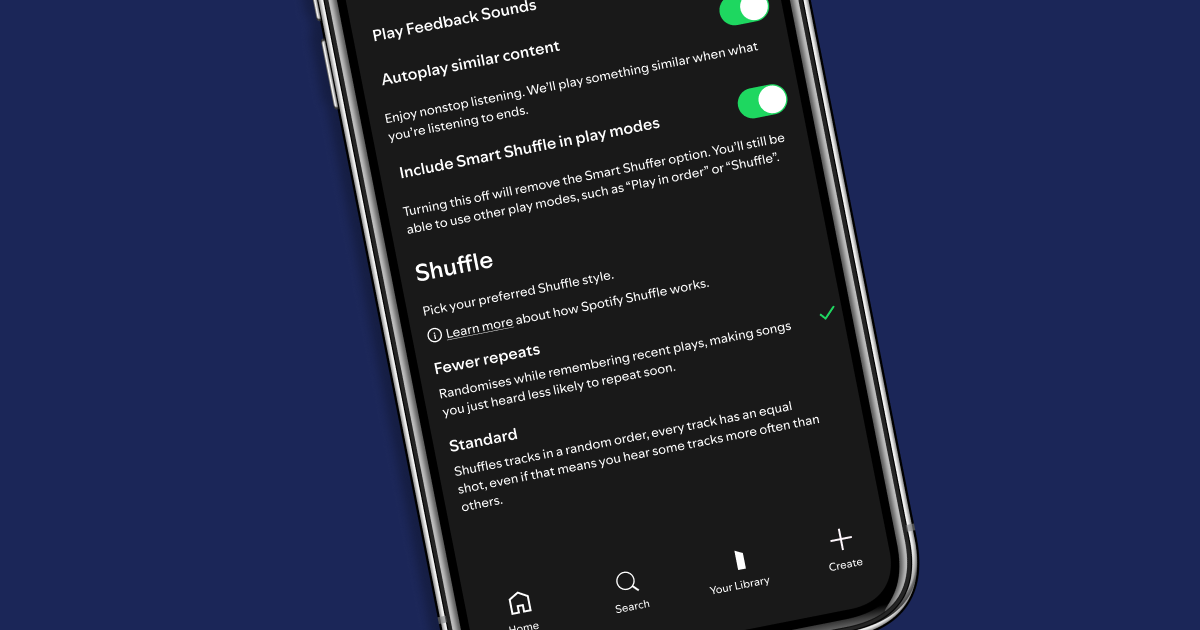
Standard Shuffle: Still Pure Randomness
For listeners who prefer the classic, purely random experience, Standard Shuffle remains available. This mode employs a well-known method called the Mersenne Twister, a sophisticated random number generator. Each song in your playlist is assigned a unique value based on a randomly calculated "seed" number, and the playlist is then ordered according to these random values. This ensures a mathematically fair and entirely unpredictable sequence.
Unlike "Fewer Repeats," this mode does not consider recent plays or listening patterns. Every track holds an equal chance of being played each time you activate Shuffle, which can, by its nature, lead to hearing the same songs more frequently.
Fine-tuning for the Future
Spotify continues to refine its methods for measuring freshness and optimizing the balance with true randomness. This includes ongoing experimentation with weighting recent plays, enhancing artist diversity, and adapting to playlist size – all while ensuring no added complexity or latency for the listener. This update, with "Fewer Repeats" as the default for Premium users and "Standard" available for pure randomness, represents a significant step forward. True randomness will always possess its inherent quirks, but by thoughtfully integrating contextual factors, we can make Shuffle sound exactly as people expect it to: unpredictable, varied, and enjoyable.