Storybook MCP Sneak Peek: Accelerating AI-Powered Component Code Generation
Discover Storybook MCP, an innovative tool equipping AI agents with your team's frontend patterns to generate high-quality, mergable code faster and with fewer tokens. Sign up for early access.
Storybook MCP Sneak Peek
Generate code with your components faster using fewer tokens.

For years, Storybook has empowered teams to meticulously define their UI. Every story, documentation entry, and test case has served as a critical record of design and behavior decisions, fostering the creation of more robust and durable frontends.
Today, coding agents are rapidly integrating into development workflows. While these agents promise faster code generation, they often produce "unmergable slop" – incorrect props, bogus states, and rendering errors – demanding significant manual correction.
The core issue is clear: AI agents lack the essential context that human developers rely on. They need to understand which components exist, their expected behavior, and what constitutes "correct" implementation. This is precisely the context Storybook provides.
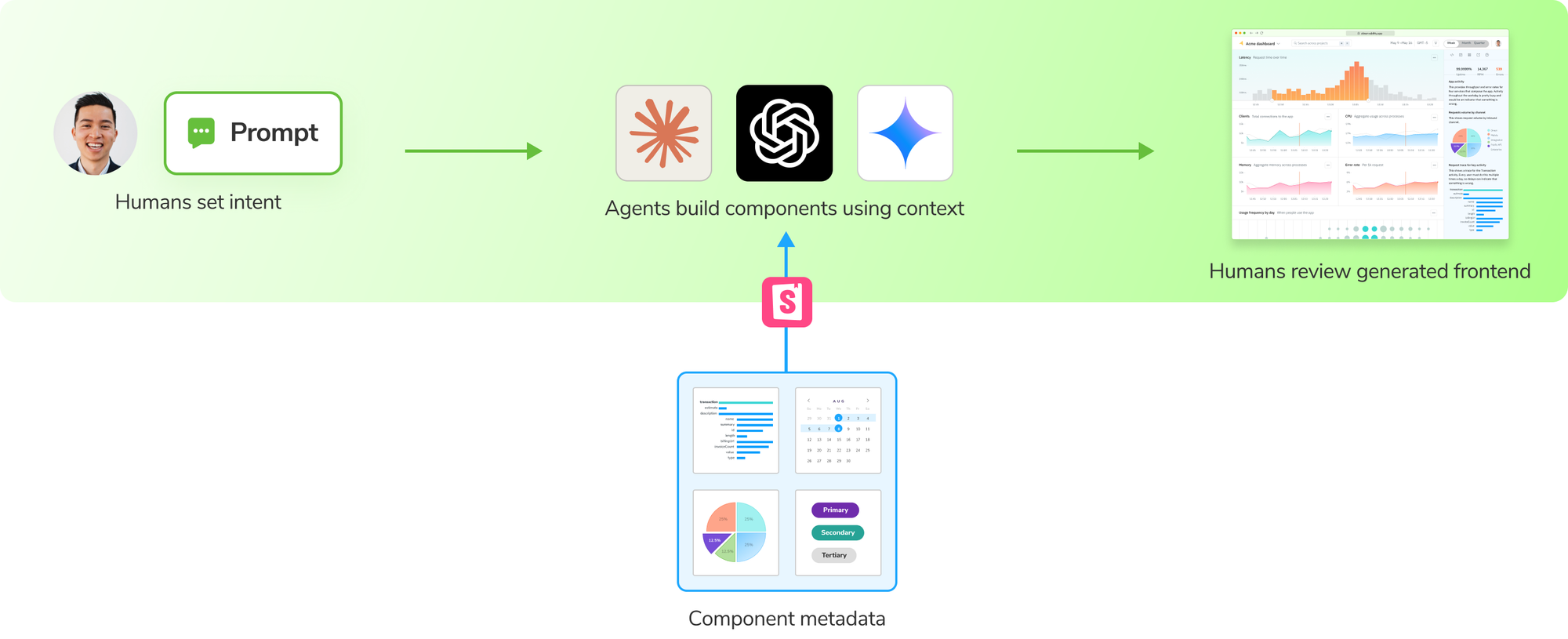
Storybook MCP bridges this gap by arming agents with your team’s unique frontend patterns. All the work you’ve invested in Storybook now becomes machine-readable context, enabling the generation of higher-quality code significantly faster and with fewer tokens.
Why now?
Every AI rollout eventually confronts a similar challenge: the generated code appears promising until integration. Agents operate at high speed but often make assumptions about patterns, leading to more time spent debugging and refactoring their output than on original development.
An agent's effectiveness is directly tied to its training data. When prompted to code, it typically defaults to average patterns. However, your Storybook stories, documentation, and tests are far from average; they precisely describe your frontend's real-world production behavior. Providing agents with this specific, high-fidelity data ensures their generated code aligns with your strict quality standards.
Can’t I just point my agent at the file system?
Simply providing more context isn't always the solution. Directing an agent to /components or node_modules mirrors the challenges a human developer faces: sifting through thousands of files, internal utilities, and complex type definitions to load relevant context. This process is both time-consuming and expensive in terms of token usage. MCP addresses this by offering agents a curated, optimized context, delivering quality results with a much smaller payload.
What’s in Storybook MCP?
Storybook MCP empowers agents to consistently adhere to your established patterns and successfully pass your tests. It equips them with two groundbreaking capabilities: machine-readable component metadata and an iterative feedback loop for autonomous error correction.
Reuse existing patterns
Quality in development often begins with intelligent reuse. Professional developers prioritize utilizing existing, robust patterns to prevent technical debt and maintain consistency.
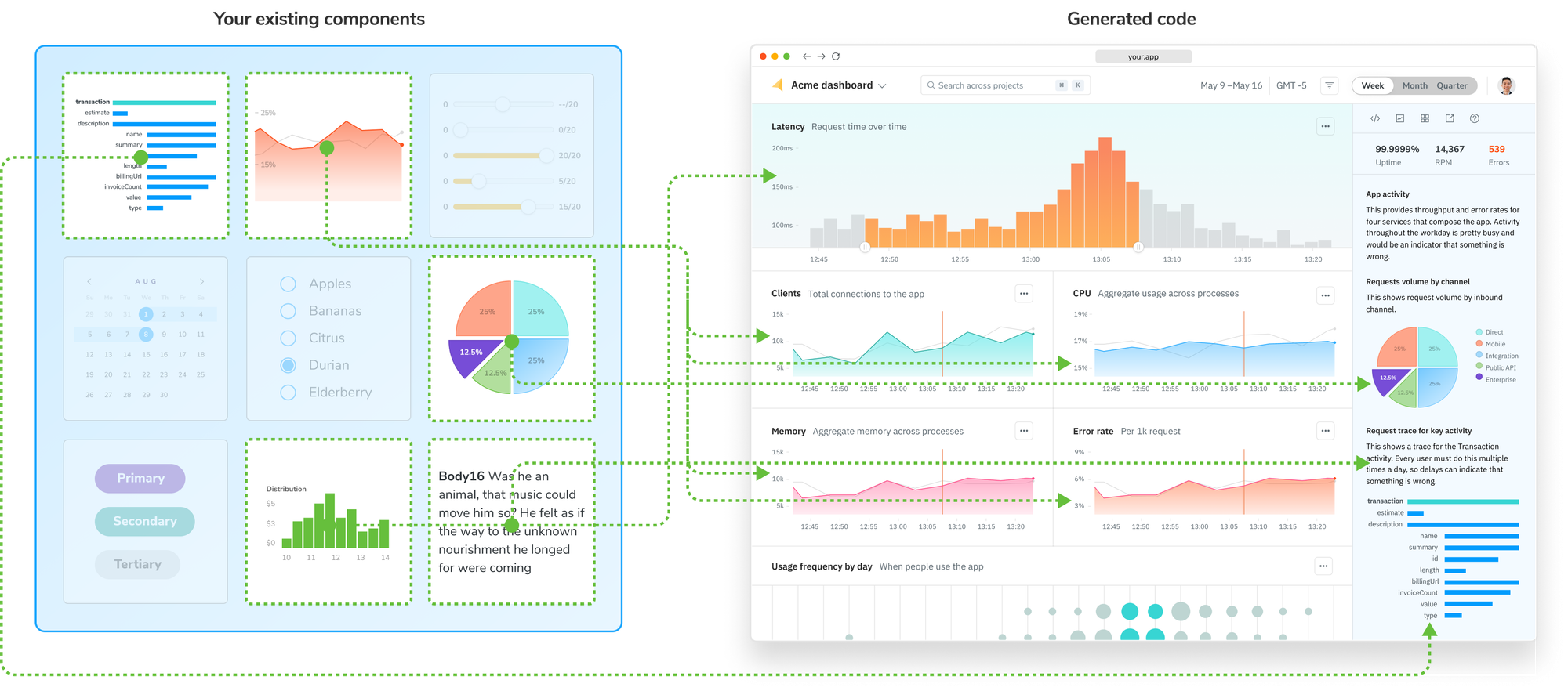
Storybook MCP delivers optimized payloads containing component metadata, usage snippets, and type definitions. This supplies agents with the most pertinent context using the fewest possible tokens.
Our benchmarks demonstrate that agents leveraging this context complete tasks faster with fewer tokens, while consistently generating code that adheres to your defined standards.
Self-heal errors and bugs
While pattern reuse significantly improves an agent's output, self-healing is what drives it to absolute correctness.
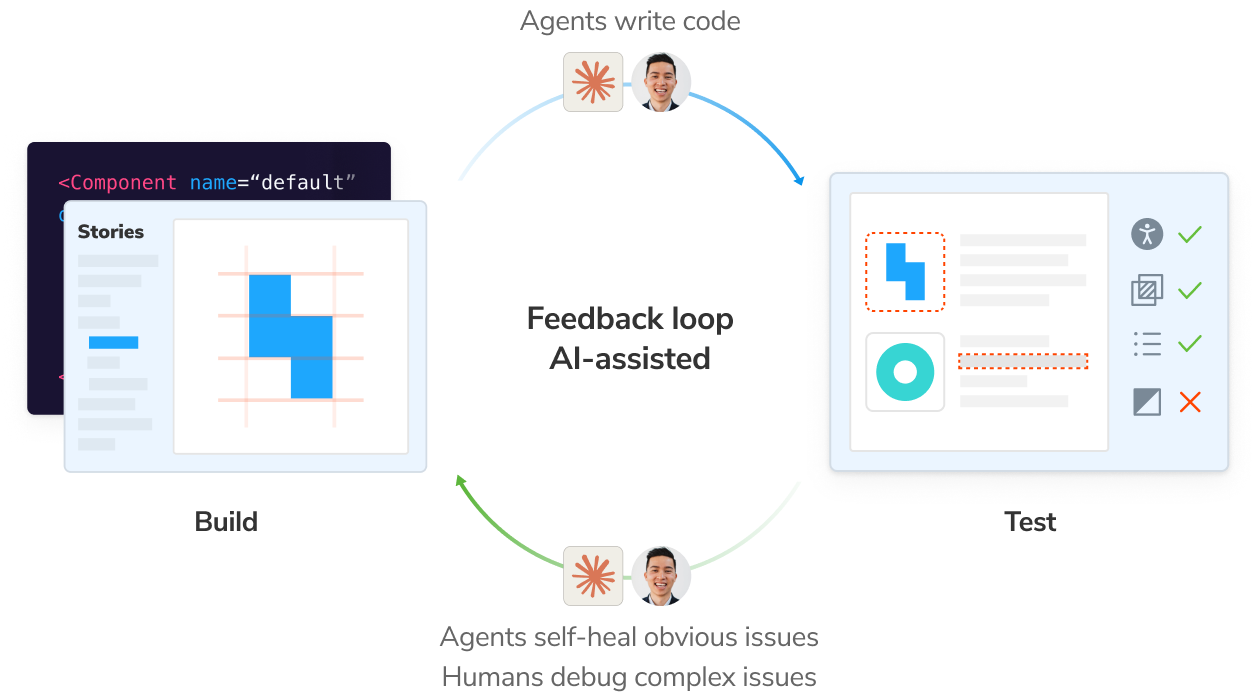
Traditional agent workflows often falter due to the absence of a feedback loop. The model generates code, declares it complete, and leaves developers to manually track down and resolve any bugs.
Storybook MCP incorporates an autonomous correction loop, enabling agents to run your component tests (including interaction and accessibility tests), identify failures, and independently rectify their own bugs. This ensures that developers only need to intervene once all tests have passed, eliminating the need for constant "prompt babysitting."
Sign up for the Early Access Program
We are actively seeking early adopters for our LLM integration, specifically from advanced design system teams. Ideal candidates meet the following criteria:
- You have a mature React design system with CI coverage
- You can update to Storybook
10.1-alpha - You have engineering bandwidth to set up the MCP workflow and tune your design system to provide necessary context
- You can actively provide feedback and be our design partner
This program is perfectly suited for teams planning AI rollouts in 2026. Participants will receive dedicated, hands-on support to integrate MCP into their existing setup. We will collaborate closely to fine-tune quality, speed, and token usage.
Early Access begins on December 2nd. Due to limited space, we highly recommend signing up promptly. Teams will be invited in small, focused cohorts.
Join the Storybook Mailing List
Get the latest news, updates, and releases directly to your inbox.
(Email input field would typically go here)
7,602 developers and counting!
We’re Hiring!
Join the innovative team behind Storybook and Chromatic. Build essential tools utilized in production by hundreds of thousands of developers. We are a remote-first company.
✨ AI