The Hero's Journey: Why Every Company Needs a Compelling Story
Discover how the universal Hero's Journey narrative arc can transform your company's strategy, engage employees and customers, and build a lasting legacy. Learn to tell your business's compelling story.
The Hero's Journey
Every company needs one
When Frodo leaves the Shire in The Lord of the Rings, he isn’t just carrying a ring; he’s carrying a story. The reluctant hero is called to adventure, finds allies and mentors, endures trials, and returns transformed, with something invaluable to offer the world. This narrative arc, known as the Hero’s Journey, is instantly recognizable because it isn’t merely Frodo’s story—it’s ours.
Such stories resonate deeply because they allow us to engage our emotions. We experience the fear of leaving home, the courage required to confront darkness, and the profound relief of hard-won triumph. Storytelling transcends mere entertainment; it’s a rehearsal space for our hearts. By immersing ourselves in someone else’s narrative, we practice hope, resilience, and transformation.
Psychologists have long contended that our minds are inherently wired for narrative. We don't simply recall facts; we weave them into stories complete with beginnings, middles, and endings. This is why courtrooms, marketing campaigns, and even casual dinner table conversations heavily rely on stories: they convert raw information into profound meaning.
Perhaps the most universal story arc is the Hero’s Journey. Mythologist Joseph Campbell meticulously distilled it into a series of stages that appear across diverse cultures and time periods: the call to adventure, crossing thresholds, facing trials, receiving aid, transformation, and ultimately, returning home. Researchers behind a recent Journal of Personality and Social Psychology study further simplified this into seven core elements: Protagonist, Shift, Quest, Allies, Challenge, Transformation, and Legacy.
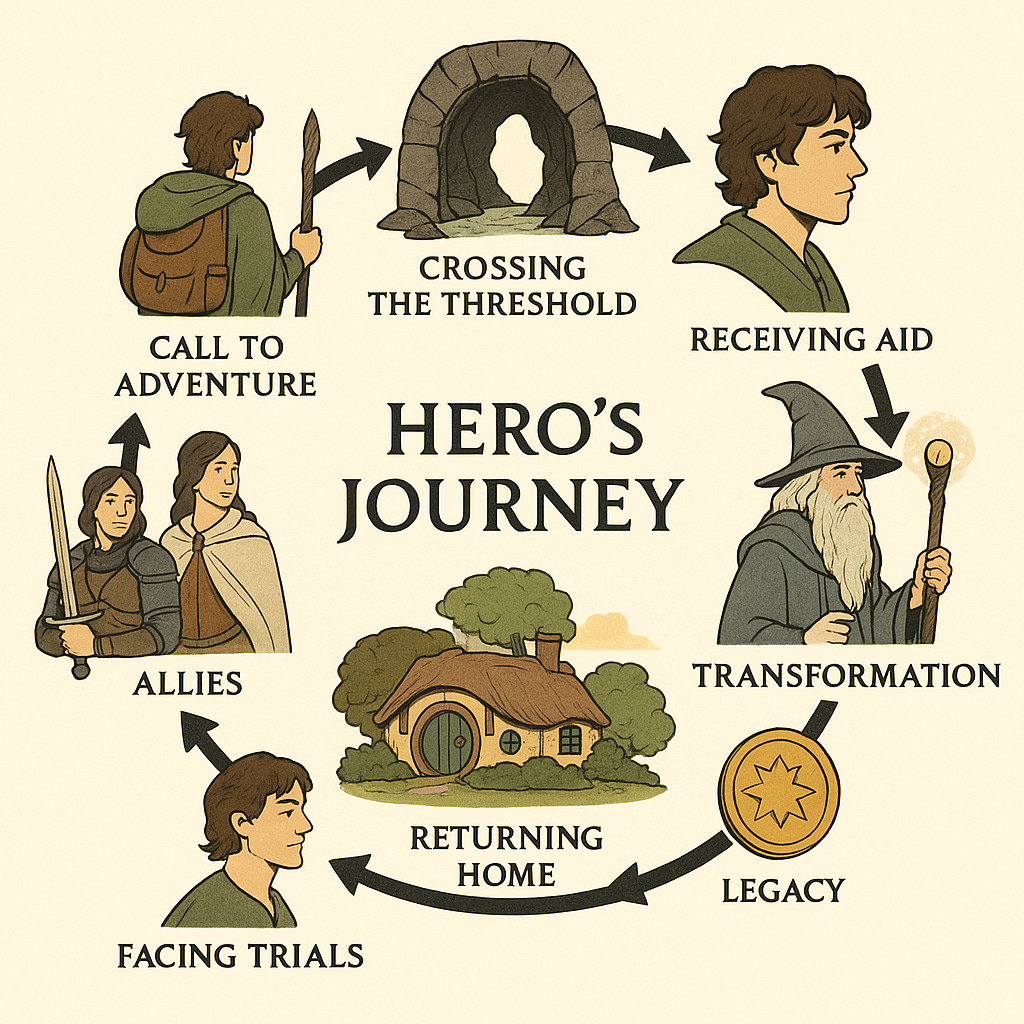
However, the Hero’s Journey isn’t exclusively personal. Companies, too, thrive on narratives. Reflect on the businesses that inspire you most. It’s seldom their balance sheets or quarterly financial reports that capture your imagination. Instead, it’s their sense of journey, the obstacles they’ve overcome, the vision they’ve pursued, and the transformation they’ve achieved. Organizations that portray themselves as heroes on a quest provide employees with a sense of belonging and purpose, customers with a reason to support them, and the world with a compelling narrative to believe in.
Consider Apple. Its legendary story began not in a gleaming corporate campus, but in a suburban garage, where two young men, Steve Jobs and Steve Wozniak, embarked on a quest to make computing personal. The challenges were immense: competitors with vastly superior resources, the company's near collapse in the 1990s, and even the ousting of Jobs himself. Yet, the journey unfolded with unexpected allies, from fiercely loyal employees to devoted early adopters. The transformation was not merely corporate survival but a profound cultural revolution, reimagining computers, phones, and music as intuitive tools of creativity. Today, Apple’s legacy extends beyond the iPhone or MacBook; it’s the enduring belief that technology can be beautifully human.
Airbnb’s origin story is equally captivating. Its founders were struggling financially, unable to afford rent in San Francisco. Their call to adventure was as modest as renting out air mattresses on their apartment floor during a design conference. The quest initially seemed absurd: who would welcome strangers into their homes? Yet, allies emerged—investors, hosts, and travelers who recognized the inherent possibility. The challenges were formidable: skeptical regulators, distrustful communities, and constant safety concerns. But Airbnb ingeniously reframed itself, not as a budget lodging service, but as a movement fostering belonging. The transformation was profound: millions of people globally opening their homes and lives to others. Its legacy, still evolving, is the promise of a world where anyone can feel at home anywhere.
Netflix offers another familiar arc. What started as a mail-order DVD rental service soon confronted a massive shift: the advent of broadband internet. This shift was both a powerful call to adventure and an existential threat. Netflix’s quest became streaming, a daring bet that almost led to the company's downfall. The challenges were formidable: intense licensing battles with Hollywood, costly technological investments, and a skeptical public still tethered to cable. Allies emerged in the form of forward-thinking engineers and creative storytellers who pioneered their original content strategy. The transformation is now undeniable: Netflix didn’t just adapt to streaming; it fundamentally reshaped global entertainment, delivering original stories from Seoul to São Paulo directly into our living rooms. Its legacy is still being written, but it has already redefined how the world consumes narrative itself.
Then there’s eBay, whose journey began with something as ordinary as a broken laser pointer. Its founder, Pierre Omidyar, created a simple website where one person’s unwanted object could become another’s treasure. The quest was clear: to democratize commerce by enabling anyone, anywhere, to buy and sell with unparalleled ease. Allies materialized in the form of millions of users who embraced the vision of a trusted online marketplace. The challenges were substantial: combating fraud, scaling infrastructure rapidly, and facing competition from established retailers. But eBay transformed not just itself but the very concept of commerce. It created a legacy of peer-to-peer trust at scale, pioneering the path for a generation of digital marketplaces that followed.
These narratives captivate us because they adhere to the same timeless arc. A protagonist embarks on a journey, confronts opposition, discovers unexpected support, changes profoundly through the struggle, and leaves behind a lasting legacy. Companies that master this narrative invite all of us—employees, customers, and partners—to see ourselves as integral to the journey. Buying an iPhone feels like joining a tribe of creative rebels. Booking an Airbnb feels like participating in a new kind of global community. Streaming on Netflix feels like being part of a revolution in storytelling. Trading on eBay feels like taking part in the internet’s original promise: a place where everyone has a voice and an opportunity.
The most impactful stories are not those that gloss over difficulties but rather those that embrace them as essential trials on the path to transformation. This is precisely why the Hero’s Journey is vital for organizations. Employees desire more than just a paycheck; they want to be protagonists in a meaningful quest. Companies that frame their struggles as intrinsic to their story cultivate resilience rather than despair. Similarly, customers don’t merely purchase products; they buy into narratives that assign them a significant role. And when businesses prioritize legacy, they convert financial success into something far more enduring: a profound contribution to the communities, industries, and societies they impact.
So, what does this mean for you? It signifies that you already possess a story, whether as an individual or as a leader of a team or company. The crucial choice lies in whether you tell it with intention. Begin by articulating your quest. What greater purpose are you pursuing? Identify your allies. Who supports you, and how can you celebrate their contributions? Confront your challenges honestly. Instead of concealing them, recognize them as the crucibles that imbue your progress with meaning. Reflect on your transformations—how you’ve grown through adversity. And finally, consider your legacy. What enduring mark do you aspire to leave behind for your family, your company, your community, and the world?
The Hero’s Journey is not about fabricating an elaborate myth. It’s about recognizing the inherent narrative structure already present in your life and work. Frodo was not extraordinary; he was an ordinary individual who nevertheless chose adventure. Apple, Airbnb, Netflix, and eBay are not flawless entities; they are flawed organizations that chose to persist, adapt, and transform. Your own story, whether personal or professional, is no different.
Therefore, here is your call to action: cease presenting your company’s story as a disparate series of initiatives, projects, or quarterly results. Instead, begin telling it as a coherent journey. Position your organization as the protagonist on a meaningful quest. Invite employees, partners, and customers to actively participate as allies. Frame obstacles not as failures but as necessary trials that hone resilience and deepen purpose. Celebrate transformations as crucial milestones in your company’s evolution. And above all, commit to building a legacy that truly matters—not solely in financial returns, but in the lasting, positive impact your organization makes on the world.
If you’re a leader, you can initiate the reframing of your organization as a Hero’s Journey by contemplating seven key questions, aligned with the research’s distilled elements:
- Protagonist: Who is the hero—your company, your customers, or both?
- Shift: What pivotal event or realization catalyzed the journey? Why does your company exist?
- Quest: What is the overarching goal or profound mission you are pursuing?
- Allies: Who are the essential partners, dedicated employees, and loyal customers who support you along the way?
- Challenge: What significant obstacles define your journey? What "dragons" must you metaphorically slay?
- Transformation: How is your company evolving and growing through these trials and experiences?
- Legacy: What lasting, meaningful contribution do you aim to leave behind for the world?
By intentionally crafting compelling answers to these questions, you don’t merely tell a better story; you cultivate a culture where people feel deeply connected and part of something far grander than themselves.
The world doesn't need another quarterly report. It needs another story worth believing in. Make yours one of them.