Your Data Model Is Your Destiny: Building Moats Through Core Abstractions
Discover how a startup's data model, not just features, determines long-term success and competitive advantage. Learn from leading companies that built enduring moats through distinctive core abstractions, especially vital in the age of AI. Optimize your product's foundation.
Your data model is your destiny. The fundamental abstractions within your product dictate whether new features aggregate into a defensible moat or simply expand an already crowded feature list. Here's how to ensure you get it right.
Product-market fit is often considered the ultimate goal for any startup. While 'product' and 'market' are undeniably crucial, a startup’s underlying data model acts as the 'dark matter' that binds them together, often overlooked but fundamentally critical.
The 'data model' defines what a startup prioritizes within its product—essentially, which aspects of reality are most significant in how the product represents its world. It comprises the core concepts or objects a startup builds around, forming the foundational assumptions of its strategy and worldview. Though partially reflected in the database architecture, it profoundly influences every aspect, from UI/UX and product marketing to pricing models and go-to-market strategies.

This foundational choice manifests differently across various layers: in the database, it dictates central tables and their relationships; in the product, it highlights dominant UI elements and simplified actions; in pricing, it determines what is charged; and in go-to-market strategy, it defines the leading workflow or pain point. Yet, all these stem from a singular decision about what should be the product's gravitational center.
Every founder operates with a data model, whether consciously chosen or implicitly inherited from existing solutions. Most never explicitly articulate it, and by the time the architecture solidifies around these implicit choices, altering it becomes nearly impossible.
Generally, this is acceptable, as most companies shouldn't necessarily innovate on their data model. Customers typically have established mental models and workflows built around incumbent tools, making direct competition expensive and slow. However, at the extreme ends of markets—where the goal is to unseat multi-billion-dollar incumbents or forge entirely new categories—a distinctive data model transforms into a critical and often subtle competitive edge.
The most successful breakout companies of the past decade frequently owe their triumphs to an early, non-obvious data model decision that, while seemingly minor at the time, proved to be decisive. Consider these examples:
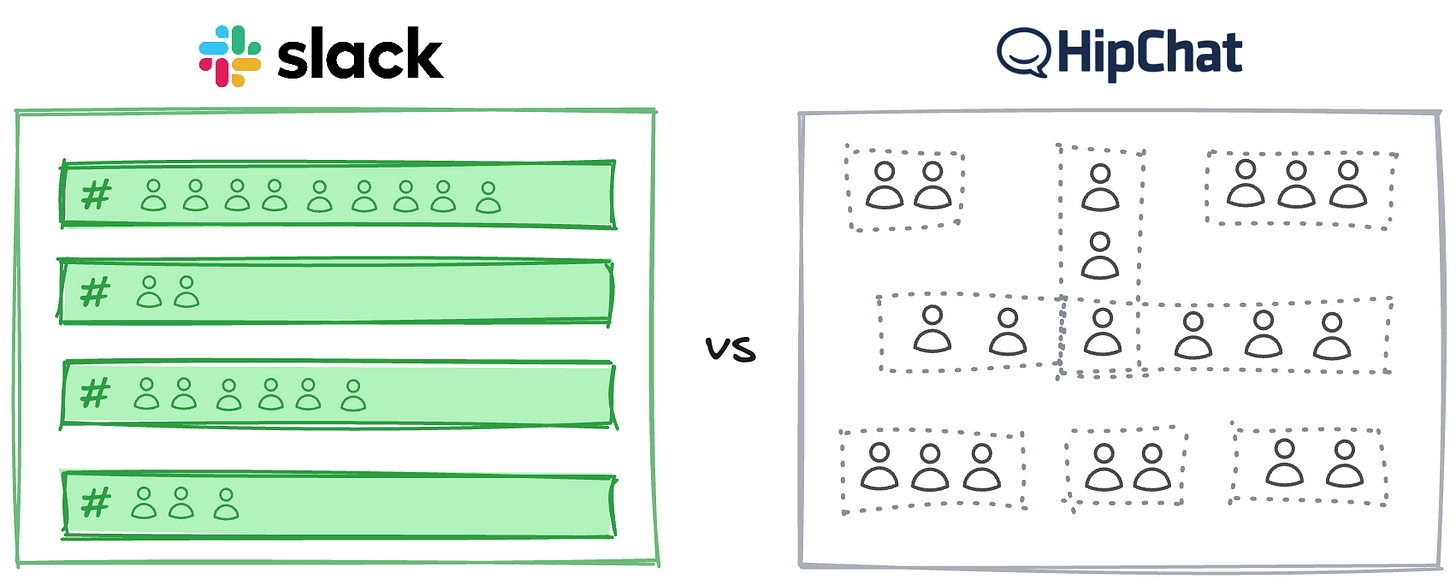
- Slack’s persistent channels vs. 1:1/group messages: While Yammer and HipChat replicated email’s ephemeral group messages, Slack made persistent, searchable channels the atomic unit. This created organizational memory—every decision, discussion, and document lives forever in context. Incumbents couldn’t match this without rebuilding from scratch.
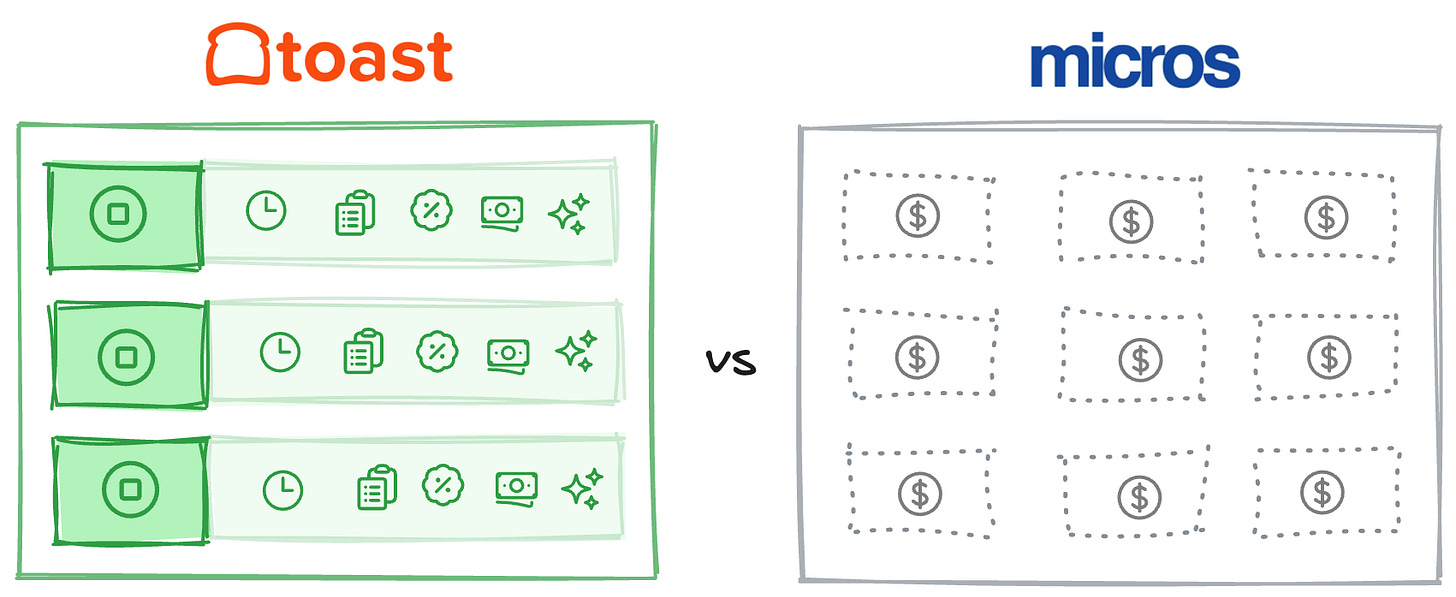
- Toast’s menu-item-centric architecture vs. generic POS SKUs: Toast makes menu items first-class objects with embedded restaurant logic—prep times, kitchen routing, and modifier hierarchies built in. Generic point-of-sale systems treat menu items as retail SKUs, requiring third-party integrations for kitchen workflows. Toast’s model enables native order routing and real-time kitchen management, plus natural extensions like ingredient-level inventory and prep-based labor scheduling—creating a locked-in ecosystem that becomes the restaurant’s operational backbone.
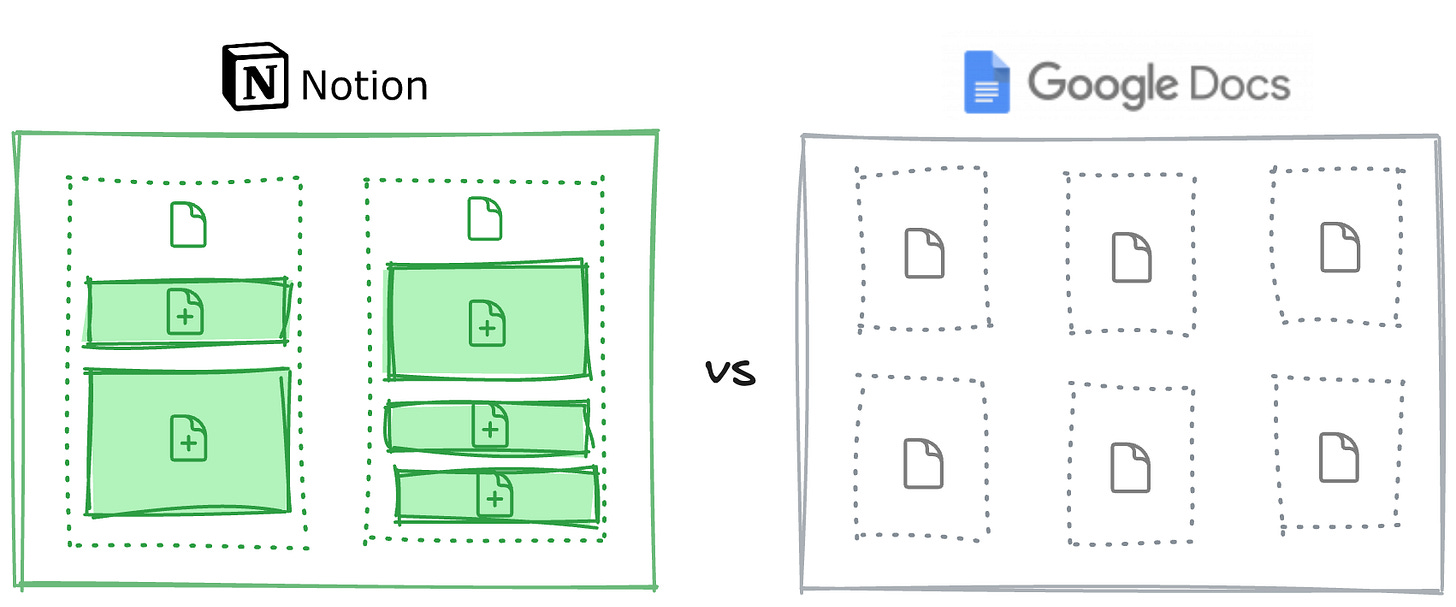
- Notion’s blocks vs. Google’s documents: Google Docs gives you documents; Notion gives you Lego blocks. Every piece of content can be rearranged, nested, or transformed into databases, kanban boards, or wikis. This modularity collapses entire tool categories into one system. Traditional tools can’t compete without abandoning their document-centric architecture.
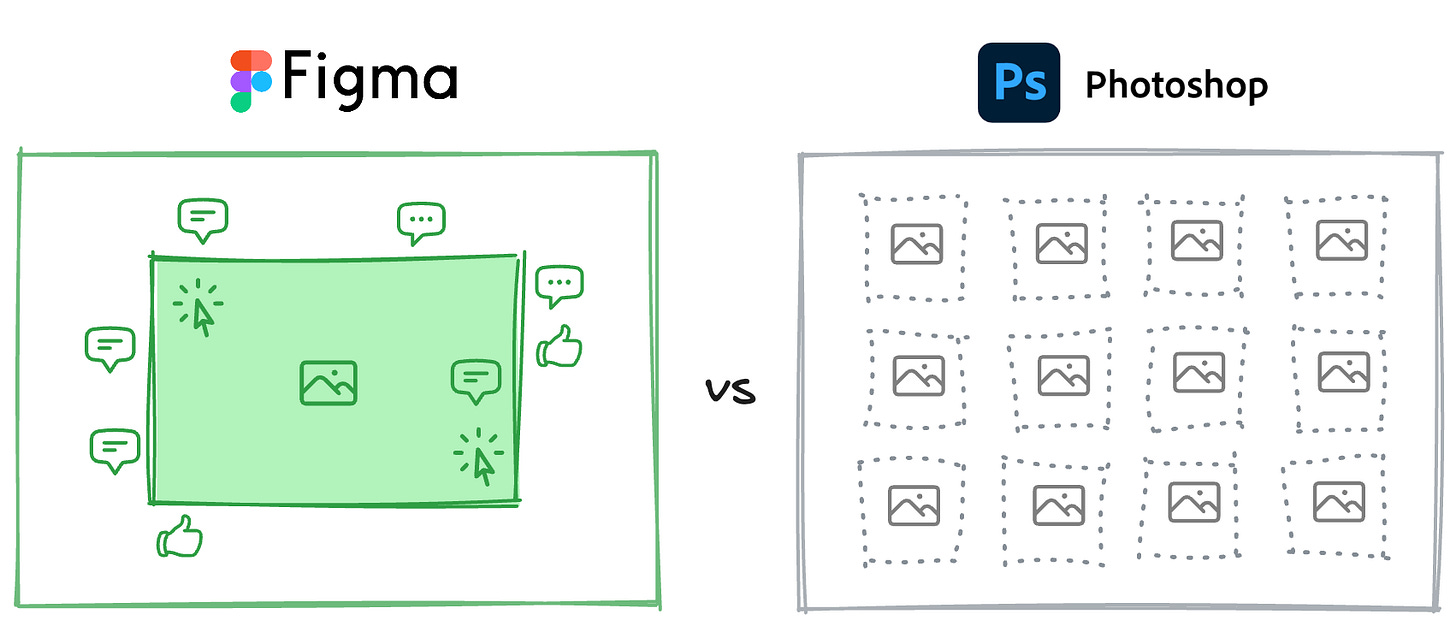
- Figma’s canvas vs. files: Photoshop and Sketch are built on local files. Figma is built on a shared web canvas where everyone sees changes instantly. This eliminates version conflicts and 'final_final_v2' chaos. Adobe couldn’t respond without deprecating their entire desktop-first ecosystem.
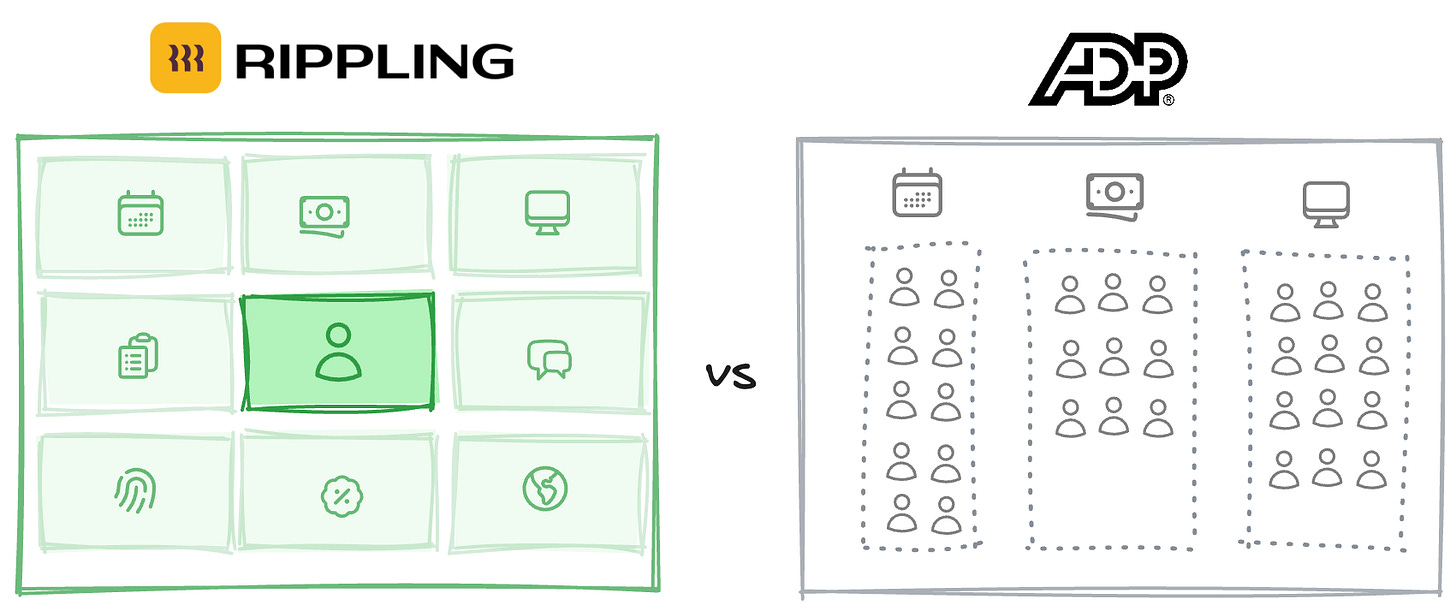
- Rippling’s employee data model vs. siloed tools: Rippling treats the employee record as the lynchpin connecting HR, IT, payroll, and finance. Not separate products sharing data, but one product with multiple views. Each new product module is automatically more powerful than standalone alternatives because it inherits full employee context. Competitors remain trapped in single categories or attempt inferior integrations.
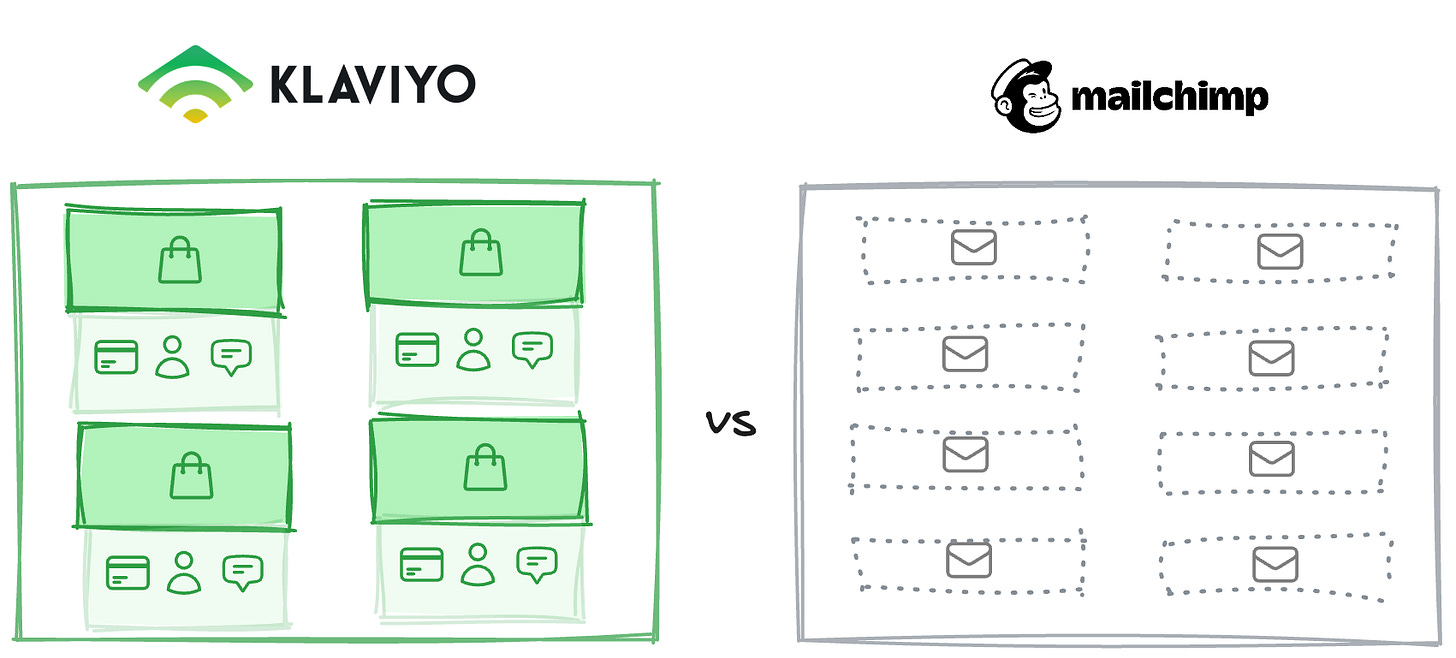
- Klaviyo’s order-centric data model vs. email-centric tools: MailChimp optimizes for email campaigns. Klaviyo optimizes for customer lifetime value by making order data a first-class citizen alongside emails. This lets e-commerce brands segment by purchase behavior, not just email engagement. Generic email tools can’t match this without rebuilding for vertical-specific data.
- ServiceNow’s connected services vs. standalone tickets: Traditional help desks treat tickets like isolated emails. ServiceNow links every ticket to a service map—showing which system is down, who owns it, and what it affects downstream. This transforms IT from ticket-closing to problem-preventing, making ServiceNow irreplaceable once companies reorganize operations around this model.

Data Models Matter More Than Ever Now
The significance of a differentiated data model is escalating dramatically. With AI commoditizing code, technical execution is fast becoming a baseline expectation rather than a competitive differentiator. AI can generate code, but it cannot easily refactor the organizational reality customers have built around an established architecture—the intricate workflows, integrations, and institutional muscle memory that accrue over time.
Concurrently, numerous markets have become so saturated that single-product companies struggle to survive. This is particularly evident in vertical markets, where companies are expanding into adjacent software products, embedding payments and other financial solutions, and even competing with their customers’ labor and supply chains using AI and managed marketplaces.
All these trends converge on a singular conclusion: in an environment where code is inexpensive, competition is fierce, and vertical depth is paramount, your data model forms the bedrock of your competitive moat. The winning companies will not be those with the most or even the best features—as AI will democratize these. Instead, victory will belong to those built upon a data model that genuinely captures a fundamental truth about their market, thereby creating compounding advantages that competitors cannot readily replicate.
Observe how this principle unfolds: Rippling's employee-centric model effortlessly facilitated the addition of payments, benefits, and spend management, with each new product module instantly gaining power from inherited rich context. Similarly, Toast’s menu-item architecture naturally extended to inventory, labor, and supplier management. The data model wasn’t merely their initial product decision; it was their platform's ultimate destiny.
Designing the Right Data Model
Designing the optimal data model is contingent on your market. For horizontal tools, the competitive advantage largely stems from technical and interface innovation. Conversely, for vertical tools, the moat is built by elevating the correct domain objects with appropriate attributes.
Horizontal tools cater to broad use cases where underlying concepts are generally familiar. Here, leverage comes from redefining how the product is built or experienced. For instance, Notion reimagined documents as composable blocks, while Figma entirely rebuilt the foundation as a collaborative, multiplayer web canvas.
Vertical tools, however, serve specific industries with deep domain complexity. Their leverage derives from what they choose to emphasize. Toast, for example, elevated menu items—not just transactions—as first-class data, incorporating prep times and kitchen routing. Klaviyo similarly promoted order data to equal status alongside email metrics.
An excellent starting point is to identify model mismatches in successful existing products. Where do incumbent products impose an incorrect or outdated model on their customers? Where do customers resort to workarounds—be it spreadsheets, low/no-code tools, or extensive in-product configurations—to force the product to align with their thinking and workflows?
Despite the significant emphasis on data models, begin with the workflow, not the technical implementation. Instead of asking 'what data do we need to store?', ask 'what is the atomic unit of work in this domain?' For restaurants, it’s the menu item; for design, it's the canvas; for employee operations, it’s the human.
If you already have a product, you can audit the strength and accuracy of your current data model. Examine your database schema to see which table has the most foreign keys pointing to it. Is this truly the atomic unit your customers conceptualize? List your product’s core actions. Do they all reinforce one central object, or are you merely constructing a 'feature buffet'? What would break if you deleted your second-most important table? If the answer is 'not much,' you likely have an suboptimal data model.
Test whether your data model generates compounding advantages. When you introduce a new feature or product, does it automatically become more powerful due to the rich data you are already capturing? If your answer is 'we’d need to build that feature from scratch with no inherited context,' you don't possess a compounding data model; you have a product suite. The correct model creates intuitive expansion paths that, in retrospect, seem obvious but were invisible to competitors.
Conclusion
Ultimately, your data model is your destiny. The inherent paradox is that this critical choice is often made when you know the least about your market, yet that is precisely why its power is so profound when executed correctly. Competitors, having already built on different foundations, cannot simply replicate your insight. They would be forced to restart from scratch, by which time you would have significantly compounded your advantage.
Matt Brown is a partner at Matrix, where he invests in and helps early-stage fintech and vertical software startups. Matrix is an early-stage VC that leads pre-seed to Series As from an $800M fund across AI, developer tools and infra, fintech, B2B software, healthcare, and more. If you’re building something interesting in fintech or vertical software, you can reach him at: mb@matrix.vc